As I was walking around San Francisco - up and down all those hills - I came across this weird looking house.
Now why would they build a house on an angle like this?
Of course, it's just a matter of perspective really.
This is how the house actually looked.
Made me reflect on my own perspectives.
Do I make judgements unthinkingly, based on my own biases and prejudice? How do I approach teaching my kids? Am I looking at the picture straight? Or am I distorting things to fit my own point of view?
Monday, 22 April 2013
Friday, 19 April 2013
Divide a Square in Half
Some time last year, I got my Year 4 class to divide a square in half and see how many ways they could do it. We had a lot of fun.
So there I was sitting in my first session at the National Council for Teachers of Mathematics (NCTM) conference in Denver this morning.
The session was titled "And The Area Is...Because!" and the presenters were Kathleen Fick and Nicola Edwards-Omolewa.
The session was fantastic. I loved it.
And the first activity set the pace.
We were given pieces of paper - origami squares - and asked to fold it in half.
How hard could that be? And how many ways could there be?
So there I was sitting in my first session at the National Council for Teachers of Mathematics (NCTM) conference in Denver this morning.
The session was titled "And The Area Is...Because!" and the presenters were Kathleen Fick and Nicola Edwards-Omolewa.
The session was fantastic. I loved it.
And the first activity set the pace.
We were given pieces of paper - origami squares - and asked to fold it in half.
How hard could that be? And how many ways could there be?
Here are some of the ways
- I'm sure there are more!
See how many you can work out!
Here is the original origami square - you can see some of the folds I used for one of the shapes.
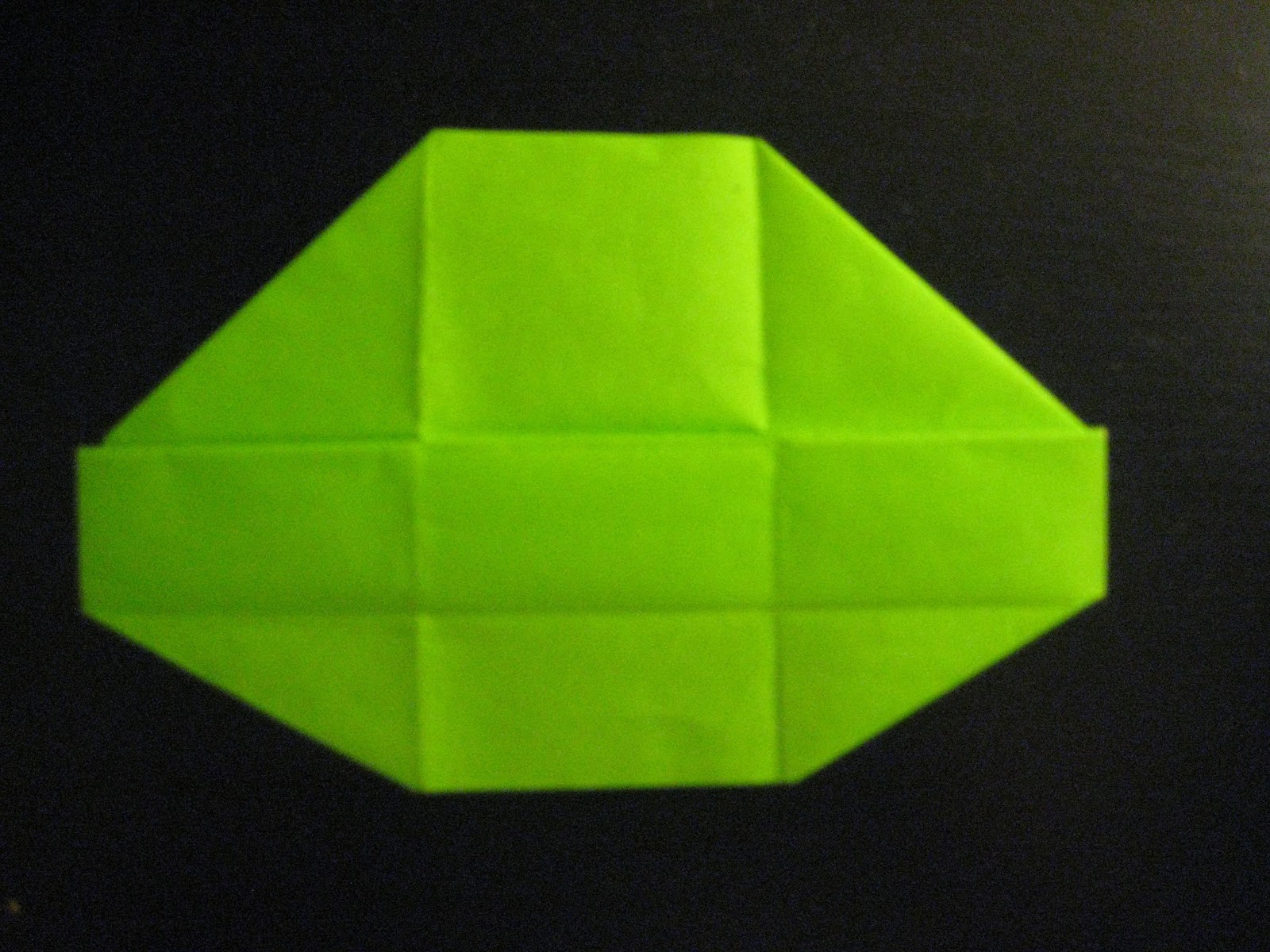
Here is a hexagon - the fold lines might help you see how it is half of the original square
The house - simple yet effective
Square - explain this to the kids in terms of fractions of the whole!
An octagon - not regular which I find annoying - I'm still working on a regular one
The kite - very nice combination of triangles
Isosceles triangle - very nice
Parallelogram - hint: the two short sides were edges of the original square
Trapezoid - this one my 4th graders showed me last year.
As one of the boys said, "Any straight line that goes through the middle of the square will cut it in half!"
Wednesday, 17 April 2013
Measure Twice, Cut Once
Any builder, or patchworker, or person who deals with things that are sold by the length, will tell you this old saying is true: "Measure twice, cut once."
I have arrived in Denver, Colorado to attend the National Council for Teachers of Mathematics (NCTM) Annual Conference later in the week. Since is was freezing outside and everything was covered in a thick layer of melted slush, I decided to take a tour of the State Capitol building.
Denver, as you may be aware, is known as the Mile High city, given its height above sea level. This fact is advertised in every second shop you pass and on all of the t-shirts and tourist paraphernalia on sale in the mall.
Anyway, part of the tour of the building took us to the stairs at the front of the building where the official brass plate showing the actual height of one mile above sea level is located - well, two brass plaques and a stone engraving. And they're all on different steps.
In 1909 when the building was completed, it was decided to mark where the actual "one mile above sea level" was so the inscription was made on the 15th step.
In 1969, someone decided to check the accuracy of the first measurement and found that it should have been on the 18th step, so a brass plaque was installed on that step.
This was again checked in 2003 using GPS technology, which found that the actual marker should be on the 13th step, so a new brass plaque was put in.
And the way global warming is going, in 50 years time the marker will need to be somewhere up near the top of the dome...
I have arrived in Denver, Colorado to attend the National Council for Teachers of Mathematics (NCTM) Annual Conference later in the week. Since is was freezing outside and everything was covered in a thick layer of melted slush, I decided to take a tour of the State Capitol building.
Denver, as you may be aware, is known as the Mile High city, given its height above sea level. This fact is advertised in every second shop you pass and on all of the t-shirts and tourist paraphernalia on sale in the mall.
Anyway, part of the tour of the building took us to the stairs at the front of the building where the official brass plate showing the actual height of one mile above sea level is located - well, two brass plaques and a stone engraving. And they're all on different steps.
In 1909 when the building was completed, it was decided to mark where the actual "one mile above sea level" was so the inscription was made on the 15th step.
The 1909 engraving
In 1969, someone decided to check the accuracy of the first measurement and found that it should have been on the 18th step, so a brass plaque was installed on that step.
The 1969 brass plaque
This was again checked in 2003 using GPS technology, which found that the actual marker should be on the 13th step, so a new brass plaque was put in.
The 2003 plaques - and you can just about see the other
indicators in the background
And the way global warming is going, in 50 years time the marker will need to be somewhere up near the top of the dome...
Monday, 15 April 2013
Using Art to Inspire Maths
As part of the "World Tour of Maths", I have spent the last week in New York visiting some schools. It has been a great opportunity to visit some classes and meet some teachers.
And yesterday, I got to visit two of the world's greatest art galleries - The Metropolitan Museum of Art and The Guggenheim Museum.
And after about 5 minutes, I started to think.
"How could I use art to inspire maths in my classroom?"
So, here are a few pictures.
How could you use them in your classroom to get a conversation started about maths?
And yesterday, I got to visit two of the world's greatest art galleries - The Metropolitan Museum of Art and The Guggenheim Museum.
And after about 5 minutes, I started to think.
"How could I use art to inspire maths in my classroom?"
So, here are a few pictures.
How could you use them in your classroom to get a conversation started about maths?
Homage to the Square: Soft Spoken
Josef Albers
Large Blue Horizontal
Ilya Bolotowsky
Second Theme
Burgoyne Diller
The Bargeman
Fernand Léger
13/3
Sol LeWitt
Composition 8
Vasily Kandinsky
Rome
Anthony Hernandez
One Million Kingdoms
Pierre Huyghe
And here's an idea...
Maybe you could build up a portfolio of pictures of artwork that stimulate and provoke mathematical conversations with your class.
Friday, 12 April 2013
Visit to KIPP AMP and KIPP Academy
In the last two days, I have visited two very impressive schools - KIPP AMP in Brooklyn and KIPP Academy in the Bronx.Both schools with a definite mission, both schools committed to quality education in their respective neighbourhoods.
And from both schools, I got the same message:
Both of these schools have explicitly stated high expectations for their students:
And from both schools, I got the same message:
Set High Expectations for the Students
Both of these schools have explicitly stated high expectations for their students:
- everyone will succeed
- everyone will learn
- everyone will graduate and go to college
The children know what is expected.
The staff know what is expected.
And so the schools have a purpose, a direction, an uncompromisingly simple vision for their actions.
But there is more.
Expectations Are Supported with Actions
And here is the killer punch - it is not enough just to set high expectations - you need to make them achievable.
So, what is the plan? What do these schools plan to do?
Well, according to the KIPP commitment to excellence form, they will "teach in the best way we know how and we will do whatever it takes for our students to learn."
And these aren't empty promises.
These teachers go the extra mile.
They work extended hours - not for extra pay but to give the kids an extra opportunity.
They work some weekends - ditto.
They communicate regularly with parents - to keep the home-school relationship healthy and to make sure there is support for the students from home.
They actively promote positive self-talk - and accept no excuses for failure or incomplete work.
They are committed to the kids - I don't think I've even been at a school where every teacher goes out into the playground at lunchtime to spend time with the kids. Or if they aren't outside, they are inside doing extra time with kids who are struggling to keep up, giving them extra support.
They are consistent with what they say - these are not hollow words. The kids know that if the teachers tell them they will learn, then they know that everything possible will be done to make this happen.
So what?
It's pretty simple really:
- Set high expectations.
- Do whatever you can to achieve these goals.
I'm sure Mr Dickens would have approved.
Thursday, 11 April 2013
Visit to The Dwight School
I was fortunate to spend a day at the Dwight School in New York this week. Fortunate because it always a privilege to see dedicated professionals going about their work with passion and enthusiasm.
There were so many great ideas that I picked up while I was there. Here are a few highlights:
Anyway, 4B was launching into their "Genius Hour", based on work by Dan Pink (who else?).
Genius Hour in 4B gave the kids an opportunity to explore some maths concepts in creative ways. In this case, they were presented with a provocative scenario - move all the classroom furniture to a new classroom upstairs - and then told all the rulers and tape measures had already been packed up and taken.
Using informal measurements, the kids explored how they were going to determine the sizes of various large pieces of furniture.
Some very interesting conversations evolved. My favourite comment was from a young boy who was measuring a table using paper clips and drinking straws.
"Will the length (of the desk) be different if I use different materials?"
Here is a link to some ideas describing what some teachers are doing for their "Genius Hour"
Next stop was a visit to 5th Grade and the amazing Posner/Watson team. The class was currently inquirying into elements and compounds that make up the world around us.
The maths activity really was an extension of their inquiry. It started with a simple discussion of H2O and the ratio of hydrogen to oxygen. This ratio was expressed as a fraction.
The kids then saw that they could explore a range of other compounds in a similar way and set to work identifying the elements in various compounds and what fraction of the whole each element was.
When I left, they were happy investigating - engaged and motivated because the work they were doing made sense, was relevant and had meaning for them - because it linked to other learning across curriculum boundaries.
In 2B, they were learning about 2-digit addition. Very cleverly, the teacher had disguised this as a lesson about playing with money.
A very significant part of this lesson was that, when children were required to show what coins they needed to make a certain total, they were required to do it in multiple ways. Simple but critically important to demonstrate depth of understanding.
Still in 2B, while the lesson was progressing, the teacher had displayed on the Smartboard a copy of the assessment rubric. The children had obviously been briefed on the rubric as they constantly referred back to it in their discussions.
"Do we need to do that?"
"Yes - it says on the rubric!"
If the kids are told explicitly what is expected, they will be able to monitor and direct their own learning.
One thing I was very aware of at Dwight was the importance that the school placed on "reflection". This was certainly true of children in all classes, where they were encouraged to reflect on the learning process, the strategies that they used and their efficiency and effectiveness.
But reflection was also practised by the staff. In my discussions with the staff, it was obvious that they thought a lot about what they did and how they did it. Not satisfied with simply maintaining the same level of quality as in previous years, there was much discussion about how things could be improved, tweeked, supplemented and augmented to do even better.
In the words of Churchill, "To improve is to change, to be perfect is to change often."
Thank you Martha, Betsy and all the staff at the Dwight School for allowing me to visit. It was a memorable day.
There were so many great ideas that I picked up while I was there. Here are a few highlights:
1. Genius Hour
The first class I visited was 4B, led by the dynamic Sharik/Beddows combination. In the class there were also 3 Aussie kids, including one Saints fan! (Go the Saints!)Anyway, 4B was launching into their "Genius Hour", based on work by Dan Pink (who else?).
Genius Hour in 4B gave the kids an opportunity to explore some maths concepts in creative ways. In this case, they were presented with a provocative scenario - move all the classroom furniture to a new classroom upstairs - and then told all the rulers and tape measures had already been packed up and taken.
Using informal measurements, the kids explored how they were going to determine the sizes of various large pieces of furniture.
Some very interesting conversations evolved. My favourite comment was from a young boy who was measuring a table using paper clips and drinking straws.
"Will the length (of the desk) be different if I use different materials?"
Here is a link to some ideas describing what some teachers are doing for their "Genius Hour"
2. Meaningful Links Across Disciplines
Next stop was a visit to 5th Grade and the amazing Posner/Watson team. The class was currently inquirying into elements and compounds that make up the world around us.
The maths activity really was an extension of their inquiry. It started with a simple discussion of H2O and the ratio of hydrogen to oxygen. This ratio was expressed as a fraction.
The kids then saw that they could explore a range of other compounds in a similar way and set to work identifying the elements in various compounds and what fraction of the whole each element was.
When I left, they were happy investigating - engaged and motivated because the work they were doing made sense, was relevant and had meaning for them - because it linked to other learning across curriculum boundaries.
3. Require Multiple Solutions
In 2B, they were learning about 2-digit addition. Very cleverly, the teacher had disguised this as a lesson about playing with money.
A very significant part of this lesson was that, when children were required to show what coins they needed to make a certain total, they were required to do it in multiple ways. Simple but critically important to demonstrate depth of understanding.
4. Publish an Assessment Rubric
Still in 2B, while the lesson was progressing, the teacher had displayed on the Smartboard a copy of the assessment rubric. The children had obviously been briefed on the rubric as they constantly referred back to it in their discussions.
"Do we need to do that?"
"Yes - it says on the rubric!"
If the kids are told explicitly what is expected, they will be able to monitor and direct their own learning.
5. Reflection
One thing I was very aware of at Dwight was the importance that the school placed on "reflection". This was certainly true of children in all classes, where they were encouraged to reflect on the learning process, the strategies that they used and their efficiency and effectiveness.
But reflection was also practised by the staff. In my discussions with the staff, it was obvious that they thought a lot about what they did and how they did it. Not satisfied with simply maintaining the same level of quality as in previous years, there was much discussion about how things could be improved, tweeked, supplemented and augmented to do even better.
In the words of Churchill, "To improve is to change, to be perfect is to change often."
Tuesday, 9 April 2013
Visit to KIPP Academy Elementary
World Tour of Maths Day 1
I would like to thank Mrs Carolyn Pettruzziello for allowing me to visit her school today and also the other staff that I spent time with. As the first school in the World Tour of Maths, I greatly appreciated the opportunity to visit classes and meet with the staff.
You know you are walking into a caring school when the principal meets every child at the front door with a smile and a kind word.
And the big thing I noticed today was the interest that the teachers took in their children. They really cared - you can't fake that level of genuine interest.
KIPP Academy Elementary - a school that cares about its kids
Maths in the Classroom
I spent most of my classroom time with 3rd Grade. This was interesting for me as I taught this level just 2 years ago.
I must say, the little kippsters knew their number facts. They were excellent with their recall of tables facts, even those odd ones like 7 x 6 and 8 x 9. Great work to get these little guys up to this.
Show Your Work
I was really impressed with some things I saw. The first thing was the great teacher questioning used to tune the kids in to what they were doing - in this case area and perimeter.
When they moved to some written questions, I saw an interesting thing. Each of the questions asked the student to "Show your work".
Without exception, every kid I saw in 3rd Grade started with a diagram. What a great strategy - draw a picture!
Next, I saw that (just about all) the students then wrote down a formula for working out area. Then they substituted values into the equation. Pretty advanced procedure for this age but certainly gave them a solid basis for problem solving.
Metric or Imperial?
I did notice that the worksheet the kids were using contained some questions using measurements in metric and others in the imperial scale. Is it common in the USA to use both? Is this a bit confusing for the kids? I know I would struggle to give it meaning if I was the one solving the problem. And were they actually measuring anything then or was it an activity involving number calculations with little reference to measurement? Just make sure you get the right unit of measurement written at the end of the answer.
Ah...bring on tomorrow and a new adventure on a galaxy far, far away...
Subscribe to:
Posts (Atom)