Showing posts with label Patterns. Show all posts

Wednesday, 21 June 2017

Patterns Inside a Circle


We are very lucky at our school to have some great resources.

Some of these may not be so obvious - like the big circle rug on the floor in my room. I decided today that we would use this rug as the base for our patterns.


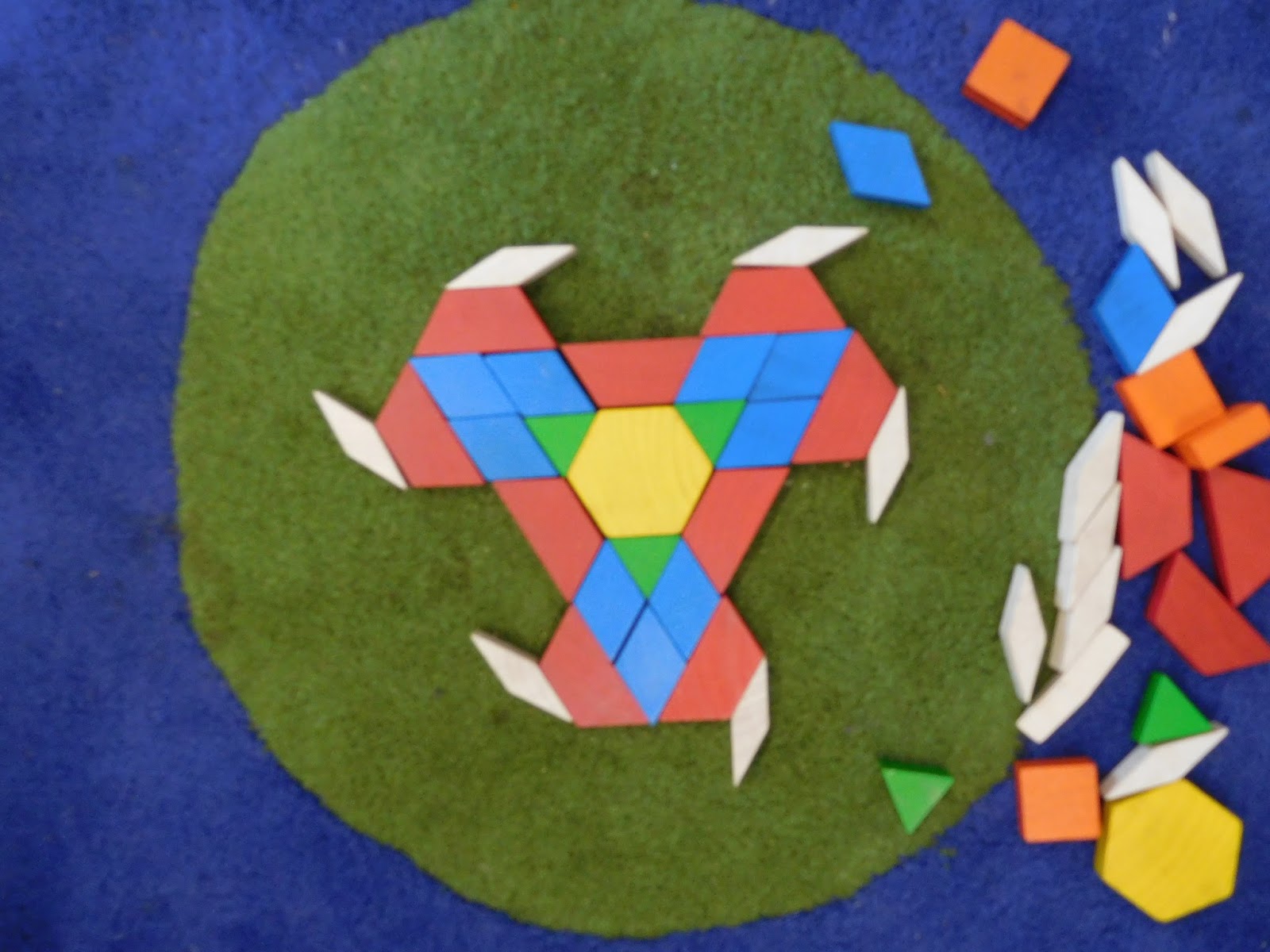
So when the kids came in, they found I had put some materials in each circle. Some had pattern blocks, some had Cuisenaire rods.


The challenge - make a pattern inside the circle using the materials provided.

Here is what the kids came up with:


Linear Patterns


Bilateral Symmetry


Rotational Symmetry


Interesting the way the kids went about this. Some took quite a while to settle on an idea. Others made several patterns. A few wanted to make pictures - the Mona Lisa, a dog, even the clock was a bit "pictorial" before I probed a bit about the need to make a pattern.

There was very little copying - or "piggy-backing" on the ideas of others. Most of the students had their own creative solutions they wanted to explore. 

I was very interested to use this a bit of an assessment moment - how far had we got in two terms? 

Results - I was impressed at the spontaneity and individuality of the students. I saw examples of different types of patterns that we had explored already. I was also able to identify a few individuals who struggled to come to terms with the task.

This is our last week before the mid-year break. See you sometime in July.

Oh - and if you are coming to the AAMT conference in Canberra, come and say hello.


Thursday, 27 August 2015

Patterns That Grow


As Marilyn Burns says, pattern is the password of mathematics.

I like playing with patterns. I use them to get the kids interested in finding relationships.

So I gave them this provocation:

Here's a pattern - 1, 5, 9, 13….

Based on this, can you tell me if 21 is going to be in this pattern? And then will 45 be in it as well?

So we got the blocks out and started making some patterns. Here is what the kids came up with:


"The pattern makes a cross shape. And 21 makes the same shape so it must be in the pattern."


"And 45 can make a really big cross too."

From talking as a group we were able to work out that yes, indeed, 45 is going to be in our pattern.

In fact one student pointed out that it was like the 4x pattern (4, 8, 12, 16…) but just one more.

It was a good starting point. The conversation was never going to end there.

What other patterns can you make? Can you explain your pattern using numbers? Can you tell me what the next number will be without making the model of it?


Here's a nice pattern - just like the cross but missing a leg.
CAn you see a link to the 3x pattern?


This one adds on a leg and goes 3D.
And now we were thinking about the 5x pattern.
Is Grade 2 too young to start talking about y = 5x + 1?


We had a good talk about this one. Is there a step missing somewhere? Should there be something between 1 and 8? Is 1 part of the pattern?


Another pattern based on squares - ah ha! Square numbers!


And then taking the square into the third dimension!


This is not the end of work with patterns for the year. We will revisit the concept many times but I feel that the kids have a good grounding now in identifying, making and explaining patterns.

And we had a lot of fun.


Tuesday, 6 May 2014

Magic Squares

I had a parent send me a link to a site that has free e-books about maths on it.


I'm always keen on free things (it's the Scottish heritage) so I went and had a look. There was a lot of books that weren't going to be that useful in Year 5 as they were aimed at university level maths. However, I did find several books that really intrigued me. I am interested in old maths text books and there were several from over 100 years ago.

One that caught my eye was called "Magic Squares and Cubes" by William Symes Andrews, published in 1908.


Well, this looked promising. Magic squares are always fun and they can't have changed much in 100 years, since they've been around since Aristotle.

So, looking through, I found some really great examples, some instructions on how to construct magic squares of different sizes, and then this diagram:


Without telling them what they were looking at, I asked my class to find patterns.

Here's what they found:


Lots of numbers increasing by 10 arranged vertically!


If you look carefully you can see that the number under each multiple of 9 is the next consecutive number. For example, under 36 is 37.


And yes we found that every row and column adds up to 369!


And the sum of all columns and rows is 6642, or 18 x 369.


It took a bit of leading to see that this grid had been constructed by using an elongated "knight's move" - four squares to the right and 1 up. 


Alternatively, you could go five squares to the left and one up because there are 9 squares in each row (5+4 = 9). 


Which made the kids think of the globe - you can travel either East or West and you will meet up at the same destination. 


Good thinking!

I wonder what other treasures I am going to find in these old books?


Monday, 15 April 2013

Using Art to Inspire Maths

As part of the "World Tour of Maths", I have spent the last week in New York visiting some schools. It has been a great opportunity to visit some classes and meet some teachers.

And yesterday, I got to visit two of the world's greatest art galleries - The Metropolitan Museum of Art and The Guggenheim Museum.

And after about 5 minutes, I started to think.

"How could I use art to inspire maths in my classroom?"

So, here are a few pictures.

How could you use them in your classroom to get a conversation started about maths?


Homage to the Square: Soft Spoken
Josef Albers


Large Blue Horizontal
Ilya Bolotowsky


Second Theme
Burgoyne Diller


The Bargeman
Fernand Léger


13/3
Sol LeWitt


Composition 8
Vasily Kandinsky 


Rome
Anthony Hernandez


One Million Kingdoms
Pierre Huyghe


And here's an idea...

Maybe you could build up a portfolio of pictures of artwork that stimulate and provoke mathematical conversations with your class. 


Thursday, 7 March 2013

The Password of Mathematics is "Pattern"

We've done a lot of inquiry-based activities in maths over the last year. It has been fascinating to watch the kids (and their teacher) develop their understanding of mathematical thinking.

But as I reflected back on what we have been doing, I started to wonder if my inquiry maths journey was more than just a series of fun activities. Shouldn't inquiry go a bit deeper?

Well, I had made an effort to link our maths to what our unit of inquiry was that we were investigating. We are a PYP school (International Baccalaureate Primary Years Programme) and we have 6 units of inquiry each year. Making authentic links is central to true transdisciplinary learning. 

But is this enough?

And what about those left-over bits of content that don't fit authentically into any of the 6 units of inquiry? You still have to teach them. We often refer to them as the "stand alone" bits of the curriculum.

Or for those who don't teach PYP, how would you approach teaching maths as an inquiry? Where would you start? Where would you go?


Numbers Patterns - A Reflection


Last week, we launched into an inquiry into number patterns. It was something we had to "cover" (don't you hate that expression - sounds like you're making a bed or tiling a bathroom floor rather than inspiring children to learn...).

Here's where we went on our journey.


Tuning In


We started with the provocation - "The Password of Mathematics is Pattern" - taken from one of my favourite books: "The I Hate Mathematics Book" by Marilyn Burns.

What did this statement mean? Does it apply for ALL mathematics? And what type of patterns are we talking about? And what is a pattern?

This was a very interesting discussion.

We followed up with the kids creating 10 of their own patterns. They shared their patterns with a partner. The partner was asked to add the next number to the pattern and explain what was happening.

Here's a few patterns they came up with. See if you can find the next number:

1, 2, 4, 8, 16, .....

8, 20, 32, 44, .....

2, 6, 7, 21, 22, 66, 67, ......

100, 50, 25, 12.5, 6.25, ......

50 000, 5 000, 500, 50, 5, .....


The debrief was interesting. Here's a few of the comments:


"Can this have 2 answers?"

"I know these two are the same but I don't know what they're called."

"Is it a pattern if you add and multiply?"

"It's a pattern if the change is regular."

"What does it look like?"

We also found one of my all-time favourite movies on Youtube:


Donald in Mathmagic Land - a 1959 Donald Duck classic. I remember watching this (several times) when I was in high school on a 16mm movie projector. 


Finding Out


Next step was to find out a bit more about patterns. Some independent research uncovered several different types of patterns. We found out about:

  • arithmetic sequences
  • geometric sequences
  • triangular numbers
  • square numbers
  • cubed numbers
  • Fibonacci sequence

Students were able to share what they found out about each type of number pattern and discussed how the patterns looked. Mathisfun.com came in handy here.


Sorting Out


Now we knew a bit about different sorts of patterns, the next step was to see if we could sort out a few examples. I provided about 20 examples of different patterns, some written numerically, some as pictures or diagrams. 

Using our 6 groups of patterns that we had identified, we proceeded to spend the next hour arguing about what went where and why. Some were easy - others less so.

Here is how it looked:


It's a bit hard to see properly but there were 22 patterns that the kids had to place in one of 6 groups.
There's a diamond-shaped pattern that is in the "Geometric Sequence" group that proved difficult.

Going Further


There are some great clips on Youtube that we had a look at, to see what other people had learnt about patterns.

Two favourites were:


Amazing Number Patterns - this we great - we watched it a few times and paused the video frequently to discuss the patterns that were presented


Nature by Numbers - an awesome visual exploration of patterns by Etereae Studios 

Then we grabbed the i-pads and headed outside to photograph any patterns that we found. Finally, we imported the photos into the Comicbook app and annotated our comic strip. This provided an opportunity for the kids to demonstrate their understanding of patterns.

Here's some examples of these:


Reflection


This inquiry cycle was conducted over 7 days. After it was concluded, I had a few questions for myself:


  • Did we actually go any further than just doing a series of fun activities?
  • Did the final activity actually provide the opportunity to show an understanding of a diversity of number patterns?
  • If "patterns" are the "password of mathematics" then shouldn't this inquiry run for a bit longer than 7 days? In fact, shouldn't it underline everything we do throughout the year?
  • And why is it being taught outside the rest of the inquiries that we are pursuing in the classroom? 
  • And where were the kids in the process? Had I pushed them in directions that I chose for them rather than letting them have a voice in the process?

Ahhh....teaching is learning!


Friday, 22 February 2013

Kindergarten Number Patterns

Working with our buddies

Every second Friday we get together with our kindergarten buddies. It is a great chance for us to socialise with the younger kids in the school and to develop a bit of leadership.

And it is fun.


Finding patterns

In her book "The I Hate Mathematics Book", Marilyn Burns revealed a great secret and mystery...


"The password of mathematics is pattern." (pg 6)

And it's true, isn't it? If you can find a pattern, you are half way to finding a solution.


Today, the kindergarteners were finishing off some inquiry into patterns. They had used a great variety of objects to build their patterns - plastic toys, feathers, hats, blocks. 


We were able to sit with them and help them record their learning, writing down their patterns and having them explain what was being repeated.


It would be really cool to get the kindy buddies outside and hunt for some patterns out there in the big wide world. I wonder what they would find?


Four young men stepping out into the world to discover some mathematics.
Any patterns out there?