Showing posts with label 2D Shapes. Show all posts

Saturday, 27 April 2013

Finding Area By Combining Shapes

I have been visiting Aoki-Chuo school in Kawaguchi, Japan this week as part of the "World Tour of Maths".

It has been an amazing experience. I have been treated like a rock star. The staff and students have been so friendly and helpful. What a great school!


Cut To The Chase


Anyway, one of the lessons I was watching involved Year 6 working out the area of shapes by looking at the shapes they are made up of.

Now, we are not talking about two triangles make a square here.

We are looking at finding an area like this:


Problem Solving the Japanese Way


One of the things I was seeing in Japanese classrooms was the way the students were encouraged, even expected, to find multiple ways to solve a problem.

Here are four ways that one student demonstrated that found the area of the shape:


Method 1


He works out that a quarter of a circle overlapped on another quarter circle makes the required overlapped shape.

So he calculates that two quarter circles have a combined area of 157cm2.

If you subtract the area of the square, you will have the overlapping shape remaining.

157cm2 - 100cm2 = 57cm2.


Method 2


In this one, he works out the area of the entire circle, subtracts this from the area of the bigger square and gets the area of the four corner pieces. This he divides by 4 to get the area of one corner piece. Then he multiplies by 2 and subtracts this total from the area of the smaller square to get the required solution.


Method 3


This time he uses a triangle and sees that the difference between the area of the triangle and the area of the quarter circle will give him half of his required shape. 


Method 4


His final method is to subtract a quarter circle from the square to get the outside corner piece. This he doubles and then subtracts from the square to get the internal shape.


What next?

Well, after they had time to work independently on their solutions, the teacher selected a few students to come and present their ideas to the class. The presentation is a very important part of the lesson and the children take it very seriously. The get a few minutes to draw their solution on some A3 paper and then stand up and talk about it. At the end they say something like, "This is what I have found to be true." and the class responds, "I agree." Then they ask for any questions, which they answer. Then they are thanked by the teacher and get a round of applause from the class.

After all the selected children had presented their solutions, the teacher left their diagrams on the board and asked the class to find similarities and differences between the various methods. This was important because the final step was to make a generalisation, a statement that could be used to help solve similar problems in the future. It is like the class summarising their learning for the lesson.


So what?


I was blown away. In the space of 45 minutes the class answered one question.

It wasn't 57 different questions from the textbook. It was one question.

But the depth of learning was very impressive. 

And at the end of the lesson, the purpose was manifestly clear - it was all about thinking.

Quality not quantity.


Tuesday, 23 April 2013

Pythagoras? When Will I Ever Use That?


You've all heard kids say it before in a lesson.

"When am I ever going to use that in real life?"

And this applies to lots of things where there's a formula or a bit of algebra and some abstract thinking.

Well, yesterday was Sunday and I was looking to find a church somewhere in San Francisco that I wanted to visit. I found it on a map. It is called the City Church on Sutter St - great church by the way if you're looking for somewhere.

Anyway, looking at the map, I had a few choices. I could go straight down Jones Street until I hit Sutter Street and then turn right (the red line).

Or I could take the hypotenuse (the green line) - much shorter!


This wasn't some clever mathematical calculation - it is just common sense. The hypotenuse is going to be shorter.

But how much shorter?

Well, if each of the other sides is about 2.5kms, then....


a2 + b2 = c2

2.52 + 2.52 = c2

c2 = 6.25 + 6.25

c2 = 12.5

c = 3.5


So I saved myself about 1.5km but cutting along the hypotenuse. 

Of course, I couldn't exactly go straight along the green line - there were houses and things in the way. My path looked a bit more like this:


Still, pretty sure it saved me some time. I got there 45 minutes before it started - which was good because I hadn't written down the exact address so I needed to walk around a bit to find the actual building. 


Well, who would have thought to look in the Russian Centre building?


POSTSCRIPT:


After posting this story, there was a certain frenzy on Twitter with several astute minds asking about the conclusions I had drawn - thanks          and any others I forgot to mention. 

The concerns raised were specifically:

  • Was the green route actually any shorter? - because it looks like it has the same vertical and horizontal distances as the red lines
  • If I was driving, did I take into account the number of left hand turns I would need to do that might slow me down
  • Were there any red lights I had to stop for?
  • And how much stopping and starting would you do if you had to make all those turns?
  • And what would that do with your mileage? 
Well, I was walking and got to cut a few corners but I take the point. Even though the green path is fractionally shorter when you walk it (by cutting the corners etc), it certainly isn't the same as going in a straight line.

And I certainly didn't save 1.5kms by doing it.

Oh, for the wings of a dove....


Friday, 19 April 2013

Divide a Square in Half

Some time last year, I got my Year 4 class to divide a square in half and see how many ways they could do it. We had a lot of fun.

So there I was sitting in my first session at the National Council for Teachers of Mathematics (NCTM) conference in Denver this morning. 

The session was titled "And The Area Is...Because!" and the presenters were Kathleen Fick and Nicola Edwards-Omolewa.

The session was fantastic. I loved it.

And the first activity set the pace. 

We were given pieces of paper - origami squares - and asked to fold it in half.

How hard could that be? And how many ways could there be?


Here are some of the ways 

- I'm sure there are more!


See how many you can work out!


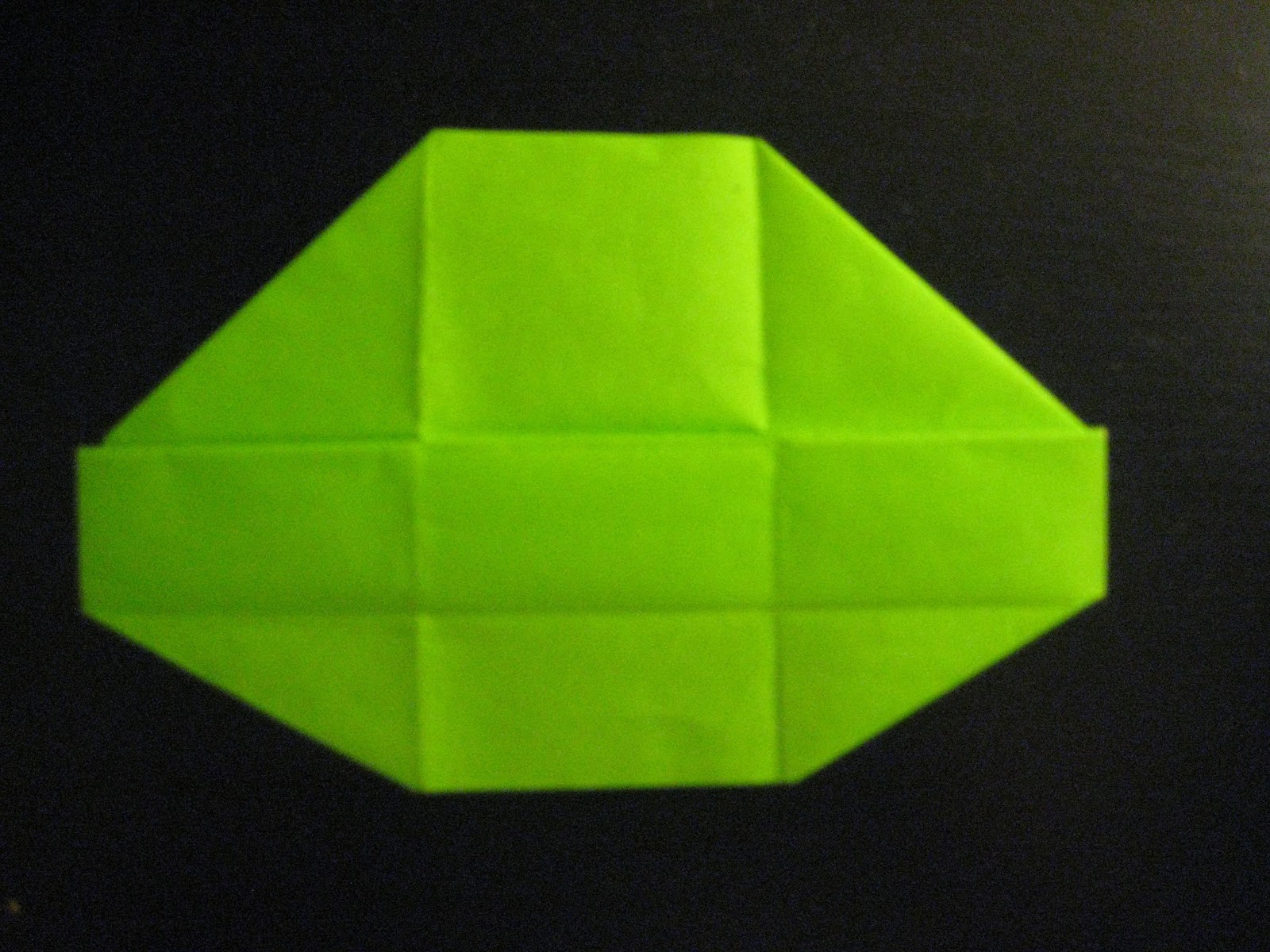
Here is the original origami square - you can see some of the folds I used for one of the shapes.


Here is a hexagon - the fold lines might help you see how it is half of the original square


The house - simple yet effective


Square - explain this to the kids in terms of fractions of the whole!


An octagon - not regular which I find annoying - I'm still working on a regular one


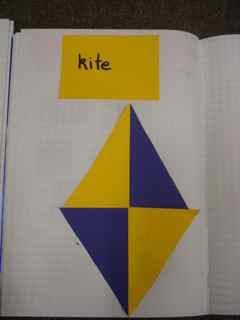
The kite - very nice combination of triangles


Isosceles triangle - very nice


Parallelogram - hint: the two short sides were edges of the original square


Trapezoid - this one my 4th graders showed me last year. 
As one of the boys said, "Any straight line that goes through the middle of the square will cut it in half!"


Wednesday, 25 July 2012

5 Things to do with Triangles

Looking for something to do with triangles?


I was scratching around for some things to do with triangles to show the kids some interesting properties of these cool shapes. I didn't want to get into Pythagoras at this point but lots of the websites and Youtube clips I found were pretty pedestrian.

So, here’s my contributions about what you can do with triangles. Hopefully they are a bit more stimulating and provocative than “put a triangle on top of a square to make a house”…


1. How many degrees in the sum of the angles of a triangle?

Cut out a triangle. Put a dot in each corner. Cut off the corners. Reassemble them to make a straight line.
How many degrees are there in the sum of the angles of a triangle?
What would happen if you used the corners from a quadrilateral? pentagon? dodecagon?


2. Diagonals making new triangles

Divide polygons up into triangles using diagonals going from one corner to another. How many triangles do you end up with if you start with:
a) a quadrilateral and join up each corner with straight line diagonals?
b) a pentagon and join up each corner with straight line diagonals?
c) a hexagon and join up each corner with straight line diagonals?


What is the pattern you can see emerging here? How many triangles would you expect to make with an octagon? And is there something special about the middle shape you create when you start with an odd-sided polygon?


3. Cross sections of a tetrahedron

Make a playdough model of a tetrahedron. Can you make a shadow that is:
a) an equilateral triangle?
b) a square

Use a plastic knife to cut a cross section. Can you make a cross-section that is:
a) an equilateral triangle?
b) a square


4. Making 3D shapes from triangles

Using triangles made from toothpicks and blutack, make 3D shapes.
a) How many triangles do you need to make a tetrahedron?
b) Ditto for an octahedron?
c) And also an icosahedron?

Have a go at making some of these shapes from cardboard. 
For some useful nets try:
http://www.learner.org/interactives/geometry/platonic.html 


5. Dividing up a triangle

Using a single straight line, cut a triangle into:
a) 2 triangles
b) a triangle and a quadrilateral
c) 2 quadrilaterals (Hmm...not sure about this one - I had an idea when I first wrote it but now I can't remember what it was. Any suggestions?)
d) anything else? (Hint – get away from the literal, flat view and think lateral)


....and have some fun!


Tuesday, 15 May 2012

Playing with Squares

Introduction

We were continuing our investigation into 2D shapes. Our next focus was on squares and what we could do with them.


Challenge 1

How many different ways can you arrange 3 squares?
  • Rule - they had to join by a complete side, not by corners or part of a side
Here's a solution as discovered by one of the students:


Significant discussion ensued about flips and turns. 
Were these shapes all different or just translations of the same shape?


Challenge 2

How many different ways can you arrange 4 squares?
  • Same rules apply
This is what we got. Note that we had by now eliminated duplications of the same shape in different orientations.


Challenge 3

Now try it with 5 squares.


A bit more difficult but we think we found them all


Challenge 4

Find the pattern.

If 1 square can have 1 solution
   2 squares has 1 solution
   3 squares has 2 solutions
4 squares has 5 solutions
5 squares has 12 solutions....

What comes next?


Friday, 4 May 2012

Playing with Quadrilaterals


After the Triangles We Followed Up With Quadrilaterals

Question was - what shapes can you make using a pair of quadrilaterals? I was most interested in following up the comment from Ross Mannell (see "Playing With Triangles" post) who suggested that it is interesting to see if kids can make odd sided shapes from quadrilaterals.

So, we got the cardboard rectangles and the scissors out and had a play.

First reaction was - "No way. You can't make a 5 or 7 sided shape from a pair of quadrilaterals!"

But after a bit of thinking, here's what we came up with:

A Pentagon:


"Excuse me Mr Ferrington,
I think I've made a pentagon!"

A Hexagon:


A hexagon with nicely labelled sides

A Heptagon:


We explored the suggestion from Ross Mannell
to use parallelograms for this one

An Octagon:


One of the first we discovered

A 32-gon:


Just a bit of whimsy but support for the theory
that the total maximum possible sides
equals number of shapes x number of their sides


In the conversations with the kids I was careful to always say "quadrilaterals" and avoid leading their thinking in any particular direction by suggesting they stick with squares or rectangle.

Lots of fun in Year 4 this week. 

Thursday, 3 May 2012

Playing With Triangles

Where did we start?

As we were exploring 2D shapes, we got some coloured card cut into rectangles. 

First job was to rule a diagonal line across the rectangle as a cutting guide. After cutting down the line we produced 2 new shapes - a pair of triangles - Viola!

Some discussion ensued - What type of triangles were they? Were they both the same? What do you mean by same? What types of triangles are there? etc

Next challenge was to see what shapes we could make with the triangles. Here's a few pictures of our results.

We found that we could use all 4 triangles to make shapes from a quadrilateral up to a dodecagon. 
- no overlapping allowed
- had to join at an edge not at a corner

4 Sides


5 Sides


6 Sides


7 Sides


8 Sides


9 Sides


10 Sides


11 Sides


12 Sides


Then we went backwards...

So we worked out that we could make a dodecagon if we had 4 triangles.

What if we only had 3?

Hmm...so we took away one triangle and found - hey we can only make up to a nonagon!


And when we had two triangles, we could only get up to a hexagon!


Amazing moment of understanding!

"Hey! That's a pattern like the 3 times tables!" exclaimed one perceptive student.

"1 triangle makes a 3 sided shape.

2 triangles can make a 6 sided shape.

3 triangles can make a 9 sided shape.

4 triangles can make a 12 sided shape."

Get the pattern?


Parting Words

"So," I said to them at the end of the maths lesson. "What is we had started with quadrilaterals instead of triangles? What would be the pattern then?"

Or if we started with pentagons?

Or if we...?