Showing posts with label Time. Show all posts

Wednesday, 4 June 2014

Year 2 Rock the Clock

I went down to visit Year 2, to catch up with all my friends down there and to see what they were doing.

Capitano Amazing, aka Mr Black, had them making their own clocks. They were pretty good at it - here is one clock face that has been divided into 60 equal parts. Great job!


The next challenge was to make some hands so we asked the kidlets, what two shapes could you use to make a clock hand?


You guessed it - a triangle and a rectangle. Wonder if there are any other combinations?

Then we all had to make a big one and a little one...


Nice going!


Oops! Too big!


Well, after we'd made the clocks and had a play with them, I wanted to explore a few number ideas that are related to time.

I put up the 100 chart on the Smartboard and started counting in 10s. What's the pattern? How do we know?

Then we counted in 5s. Same questions. What does it look like on the chart?

Then we did counting by 6. We've had a few parents getting anxious about kids needing to know their tables facts so I was interested to see how these Year 2 champs would come with counting by 6.

They smashed it.

Then we started to look at the patterns that were made.


"Well," said one legend, "If you look at the diagonal pattern on the right, the numbers are going up by 12. If you look at the diagonal pattern on the left, they are going up by 18."

Nice. And this is Year 2.

Next followed a conversation about multiples of 6, the number of minutes in an hour, the number of seconds in an hour, etc. Very enlightening.


Time for the final challenge


"Okay," I said, "You know that there are 60 minutes in an hour. What would an hour look like if one minute looked like this:


or this.....


or this....


or...


"Show me what an hour would look like."


And this is why I love teaching...


Because the kids come up with some crazy ideas that I had never anticipated.


There we go - 60 minutes!


Not convinced? Let me show you...


Ta da! 10 rows of 6 = 60


Or try this...


Don't believe this is 60 minutes?


How about this then? 12 x 5 = 60


And how long is an hour?


Ooh, about this long...


...or maybe this long.

Then we had the "Hour Tower"...


...and the "Block Clock"


What are you talking about???

And finally one bright little champion came up to me and said, "Here is an hour Mr Ferrington":


"What are you talking about? You've only got two blocks!" I exclaimed.

"Well, each block is 30 minutes," he replied patiently.

Come on teacher - keep up!


The End


So we got to the end of the afternoon and I congratulated the kids on doing a great job and working on maths for an hour and half.

"No - it was only and hour and quarter," said one.

"I think it was about an hour an 17 minutes," said another...


Monday, 9 April 2012

Some great ideas for investigating "Time'

So you want to investigate "Time"?

Investigating how to measure time? Here's a few different ideas that you might like to use as a provocation to get the kids thinking.


One-Handed Clock

I got this idea from a colleague on Twitter (@turtletoms) and I think it sounds great. Fortunately I dropped my classroom clock last week when I was taking it down to change for the end of daylight savings. The clock ended up in pieces but I should be able to resurrect it for school tomorrow morning.

So, remove the second and the minute hands from the clock and leave only the hour hand. Use this as the timepiece for the day (or week) so that the kids get the idea of what the hour hand does. Where is it at the half hour? At quarter past? At ten minutes to? Hopefully they will also get to appreciate the need for the other hands. A great way to explore what the clock does and the relationship between the parts. 


Digging a bit deeper, it seems that clocks originally only had one hand. People living in countries with very old clock towers may be familiar with this fact. 


Timeline - Till Rolls

I acquired a box of till rolls from my wife's pharmacy when they upgraded their cash registers to a point of sale system a few years ago. The new machines use different sized paper so I got all the old ones. The long strips of paper are really useful in lots of Maths investigations.


I gave the kids a long strip of paper each. I then asked them to divide the paper into 24 equal sections - we used the width of their ruler for convenience. Then they drew in each box what they were doing in each of the hours and labelled the times appropriately. If you wanted to introduce the idea of a time-scale, you could make each section 6cm long so that 1mm = 1 minute. The strip would need to be 144cm long (24 x 6cm).


You can also use other time scales - weeks, months, years etc.


I have also seen a strip of paper wrapped around the circumference of a wall clock and the parts of the hour (half, quarters, 5 minute increments) were then marked on the paper. When the strip of paper is unrolled, the students can see the "hour" as a length and each of the time divisions as a fraction of the whole or as a number line. 


School Bells


A favourite little Glasga school yard song goes....


The bell, the bell, the b-i-l

Tell my teacher I'm no' well
If I'm late, shut the gate
The bell, the bell, the b-i-l

Apparently poor spelling is a consequence of truancy.


Anyway, at our school we have a bell that rings to indicate break times, probably much like most schools around the place. I am a bit perplexed that everyone, children and adults alike, accept that the time the bell rings is the actual time it is meant to ring.


You can use one of many on-line clocks to check the accuracy of your school bells:


http://www.thetimenow.com/ - this is not very easy for people with visual impairment to see

www.thetimenow.com - this one is easier to see
http://www.timeanddate.com/
https://greenwichmeantime.com/
http://www.time.gov/ - time in USA

..and there are many more.


Put the digital clock of your choice up on a screen and keep a record of when your school bells rings. Compare this with when the bell is supposed to ring.


How many days old are you?


There are web-sites where you can plug in your birthdate and it will calculate your age such as:


http://www.mathcats.com/explore/agecalculator.html

http://www.capoferri.com/howold.htm
http://www.time-for-time.com/howold.htm
http://www.onlineconversion.com/howold.htm


...and the list goes on.


But, before showing these to the kids, I would be really interested to see how they would go about working it out. This is not an open-ended task but it has great potential to explore problem solving strategies. Allow significant time for kids to work through a series of mistakes and miscalculations (we call these "opportunities to learn" in 4BF). See if they can come up with a "formula" that can be applied to any birthdate.


Then I'd let them loose on the websites to see how accurate their own calculations are.


Stop the Clock


And just for fun, a favourite website of mine that is pure enjoyment - the kids and I all love the big bang noise when you finish and it says, "STOP.....THE.....CLOCK!"


Give it a go:


http://www.teachingtime.co.uk/


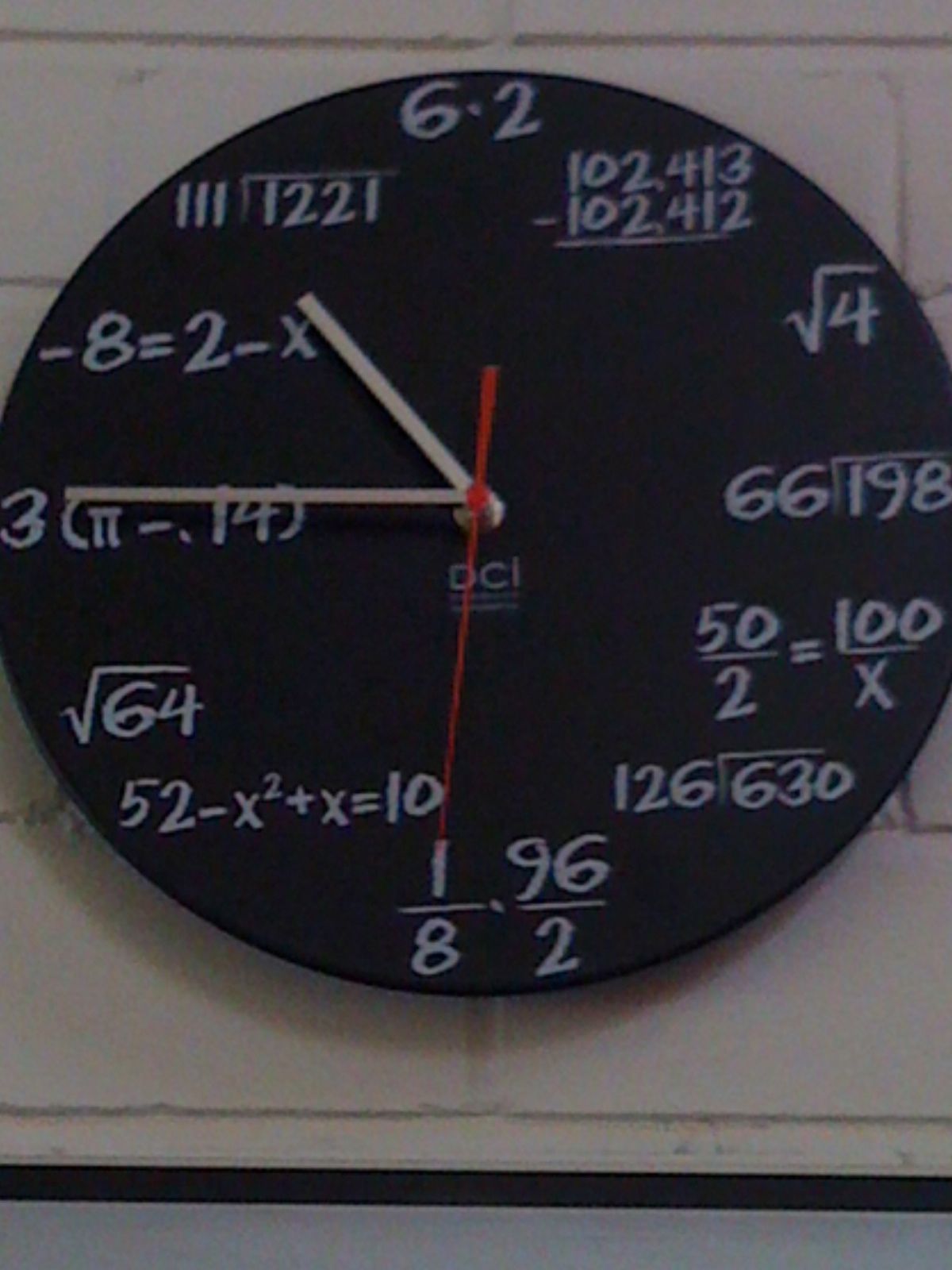
Maths Clock


And here is a picture of the classroom clock from my daughter's maths classroom:


Thanks Mr H for the inspiring idea!


Historical Note

I was reading a book last year called "The Case of the Hail Mary Celeste", a speculative fiction book by Malcolm Pryce. In the book, Pryce mentions that time zones were not formalised until the advent of railway lines. The railway timetable meant that some sort of standardisation was needed across countries where previously each town and city had had marginally different times based on their meridian of longitude. 


"No way," I thought. "Interesting idea to make your book that bit quirkier than it already is..."


But he was right. From about 1840, the UK, USA, India and Europe all had to find a way to 


Across England there were towns that "held out" against the imposition of "London time", such as Bristol and Exeter. In Bristol, for example, the town clock introduced an additional minute hand two, one to show "London" or "Railway" time and one to show true local time.


Bristol clock with and extra minute hand.


...and the book that prompted my personal inquiry into time.


Friday, 6 April 2012

How did they measure time back before time began?

Introduction

In 4BF we are currently investigating "Time". I wasn't really interested in printing off pages of clock faces from the free download sites. I wanted to get a bit deeper into the concept of measuring time itself. Yes, we did spend some time revising our skills and discussing the mechanics of telling the time but the focus was always going to be on something bigger and better.

Here's where we went...


Using Sand Timers

After a bit of a discussion on historical lines, the kids identified a few early time-measuring devices. We had a good collection of sand timers in the storeroom, so we took them outside and had a play.

Activity 1 - see how many times you can walk around the quad before your sand timer runs out. Repeat this three times.

A pretty basic measurement activity but highly enjoyable.


Using Water Timers

Activity 2 - see how long it takes to empty your water bottle into the garden. Repeat this three times.

By the time we got to the second activity, the kids were beginning to question why they had to do each activity multiple times.


Using Rice Timers

Activity 3 - see how long it takes to pour a container of rice through a funnel and into a second container. Repeat this three times.

We used stopwatches to time Activity 2 and 3. By timing each activity multiple times, the kids were able to see the variability of each method and question the accuracy of water timers and such devices.


SO FAR...

Well, so far it's been a lot of fun but it was still pretty much teacher-centred. I asked some questions and gave out some equipment and the kids went off and explored the way I wanted them too. It was time to loosen up a bit and see where the kids wanted to head.

Design Your Own

Activity 4 - design and build a device to measure 10 seconds.

After some more discussion about measuring time and what it all meant, we agreed that it might be interesting to see if we could build out own timing device. Some suggestions were going to be a bit impractical (in a school context - like how to measure really long periods of time like seasons or years - but it showed that someone was thinking big picture ideas) we settled on measuring 10 seconds.

The children were given two days to work on their device, some class time but most kids worked at home on testing and producing the device. Results were all really exciting and the kids spent significant time trialling and modifying their designs. Here are a few examples of what was produced:


A simple "sand" timer using 2 plastic bottles and rice. Interestingly, the timing was faster when pouring from the bigger bottle to the smaller than when it was inverted. This provoked much discusion about why, what caused this, did the sizes of the opennings matter, etc


This was a rather complicated, but effective, arrangement of three plastic cups connected with string. The red-coloured water in the top cup (note the fill linein black) runs through a hole in bottom, down the string into cup #2 and then through a hole in the bottom of that into cup #3.

Following more conversation about alternative timing devices, three kids came back to school the next day with candles that they had scaled to measure time. One girl had bought 2 identical candles and set the timer on her iPod to beep each hour. She light one candle and saved the second one. Then she marked the scale on the unused candle each hour when the iPod went off. I loved the juxtaposition of the iPod and the candle clock!


Here's a pic of one of the candle clocks. We have a few more in the pipeline and will post them when they are ready - hopefully tomorrow.

All in all, lots of fun, some good inquiry, lots of questions and I think we all learnt something about measuring time!