Showing posts with label Laws of Maths. Show all posts

Tuesday, 11 March 2014

The Laws of Maths - The Associative Law with Multiplication

We're getting close to the end of our time looking at the Laws of Maths (and the kids will be glad to move on to something new).

So, we brought the multiplication process into the Associative spotlight.


Now we were getting into some interesting territory.


Having spent the last two weeks:
1. learning about the Commutative and Associative Laws
and..
2. experimenting with using arrays

...we were now in a place where we could start thinking for ourselves and the teacher could take a bit more of a backseat.

So once again we pulled out the counters and started thinking about the provocation.


 A nice looking display - at the top we have 5 groups of 4 x 2
and underneath we can see 2 groups of 4 x 5


 So when we put them together we can see that the two groups
are the same. Nice proof.
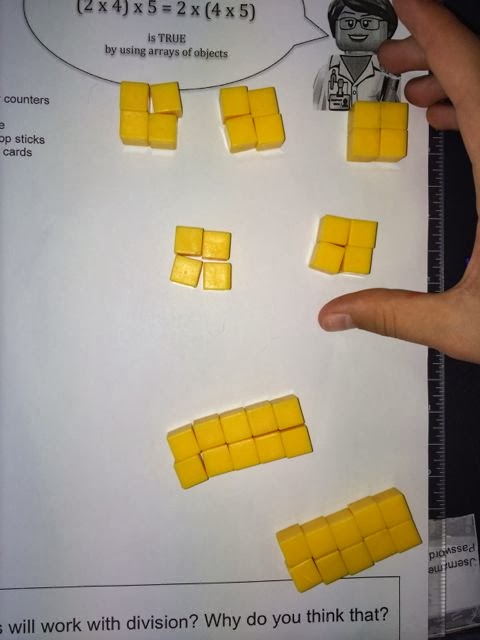


This one was a bit confusing to me. We've got 4 x 5 at the top
and 2 lots of 2 x 5 at the bottom. Not quite the same as the provocation at the top.


So we reorganised things a bit and had a chat about what we were looking for.
I find these little chats that follow moments of confusion really significant -
helps me to assess and diagnose.


And just when I thought everything was going so smoothly, I came across this
example of someone trying to model the symbolic notation using blocks
rather than making an array. 
Time to reflect on my tuning in process for this inquiry.


Having come this far, we are going to finish with the Distributive Law later in the week.

Can't do it tomorrow because we have "Gruffalo Day"

...but that is another story!


Tuesday, 4 March 2014

The Laws of Maths - The Commutative Law with Multiplication

Our conversation about the Laws of Maths has moved on this week to consider multiplication.

How do the Laws that we have discussed so far apply here?

Let's have a look at the Commutative Law.

Here's what our provocation looked like:


So, after a bit of tuning in that looked like this:


We did the "1 Minute Challenge" and then had a look at the grid.
I find this really interesting and helpful for the kids to get them focused
on what they already know and what they need to learn.
As we go on, they can colour in the tables facts they "master".

And then it was on to the fun and games.

How do you prove the provocation is correct?


So, I was really keen to get the kids to use arrays for this one, partly because I don't think they have used them very effectively in the past and also because they are going to need them when we start talking about the Distributive Law - stay tuned for that one!

When we got started, we decided it might be a good idea to make two arrays: 
one that was 4 x 9 
and the other that was 9 x 4

But were they going to look any different? 

And how could we demonstrate that they are equivalent?  


After a mad scramble for the blocks...


...we found that 9 groups of 4...


...and 4 groups of 9 take up the same space.
Seems obvious but it was really good to see it.


Some groups lined all their blocks up to compare the length and see that it was equal.


Not everything went to plan. Here's a few problems we encountered:


So here we have 4 groups of nine, which is obviously longer than 9 groups of 4... 


A simple problem, but an important one. Yes - you actually need to count accurately when using blocks. These guys got a bit carried away and the 4 groups of 9 included one group of 10 and one of 11.


This one is fascinating. It shows the alert teacher that here are some students who don't get the idea of arrays, don't understand how to use blocks to represent number facts and who missed the point of the activity.

Back to the drawing board...


So we made 9 groups of 4 and also 4 groups of 9...


...and with a bit of reorganising we could see they looked the same!


So what?


It's not rocket science, I know, but having done this activity...

1. we can now construct an array

2. we can demonstrate the Commutative Law as it applies to multiplication

3. we can see what we are talking about (abstract idea made concrete through modelling)

4. we all now know that 4 x 9 = 36

5. ...and we got the blocks out and had some fun.


Thursday, 20 February 2014

89 and 98

Sometimes the kids come up with some amazing things.

This happened a few days ago.

A young boy was working on activity to do with the Commutative Law. The example we were using involved the sum:


57 + 32 = 32 + 57

In the process of this investigation, the student started to play with the numbers.

"Hey," he said, "Have you noticed that any two numbers that add up to 89, like 57 and 32, can be reversed and the new answer is always 98?"

What?

Try it.

57 + 32 = 89
75 + 23 = 98

61 + 28 = 89
16 + 82 = 98

25 + 64 = 89
52 + 46 = 98


etc.

He was right. Having played around with these numbers, I've got an idea about why this happens.

But to get this young boy thinking, I've asked him to look at other 2-digit numbers that end in 9, and three-digit numbers, and is there a pattern, and....


Tuesday, 18 February 2014

The Laws of Maths - The Associative Law

Today we had a look at how the Associative Law relates to addition. It wasn't an inspiring exercise - it was after lunch, it was hot, the kids were tired and so was I. Also, it wasn't that different from what we did yesterday, as one student quickly pointed out. 

So I really have to commend the class for the great things they came up with.


Our provocation here looked at what happens when you are adding more than two numbers together. I chose to use 2-digit numbers as practice for my new class, to see what their addition skills were like at the same time as investigating the Associative Law. (happy to report - skills pretty good!)


Just like yesterday when we looked at the Commutative Law, I was keen for the kids to present multiple strategies to prove the provocation was correct. This time I suggested using balance scales as one option. I was wanting to promote the idea that "=" is not the "here comes the answer" sign but is in fact the "that side equals/is the same as this side" sign.

So, when we sat down and got out the gear, the kids started to produce some interesting ideas to prove the provocation was true.

Here are some of the ideas they came up with:


The number line is always a good choice. I can see the numbers used as the starting point but not the individual numbers that are added to it, only the combined value of the other two numbers: 75 (= 32 + 43) and 100 (= 43 + 57)


Another number line. This time the jumps use the individual addends without breaking them down into smaller parts. The top number line shows the combinations of each pair of numbers when added. This is applied to the bottom number line to show what happens when you start with each of the three numbers and how all combinations end up at 132.


Using tally marks is a slow process but it shows that you end up with the same value regardless of the order in which you write them.


And here is the story of Tom, Tim and Terry. They stand on each other's heads and still achieve the same combined height, which isn't very tall - only 132mm. Great use of length to show how to add numbers.


Ahh...here's the balance scales. If you count out the value of each number using the Base-10 material and put them into either side of the scales, it balances out. One of my favourite ways to demonstrate equality.


I saved this one for last because it is intriguing. The target total (132) is written in the centre triangle. At each corner are the three numbers from the provocation - 43, 32 and 57. Then between each of these numbers is the sum of the pairs: 
57 + 32 = 89; 32 + 43 = 75; 57 + 43 = 100
Then if you follow the lines around the outside you can see what numbers will combine to equal 132.
I'm not sure where this boy got this idea - but I like it!


So - lots of fun. Not sure where we head tomorrow. The plan is to start to mess with their heads and introduce subtraction into the Commutative and Associative Laws... 


Monday, 17 February 2014

The Laws of Maths - The Commutative Law

We have started our year inquiring into "How the World Works", looking at how a knowledge of the laws of science helps us to understand the world in which we live.

And, of course, a knowledge of the Laws of Mathematics is central to this understanding.

So, we started with the Commutative Law. 


With this provocation, I wanted to see what the kids knew about addition, the relationship between addends and how the Commutative Law works.

So I asked them to show that this statement was true using 3 different methods.


This was the first time I had done something like this with the kids this year. It was probably the first time some of them had ever done "proofs" or tried to explain their ideas using multiple strategies.

Here is what they came up with:


Coloured counters are used here to represent the Tens and Units columns, an unusual way to show place value. It doesn't really answer the question for me and tells me I need to spend some more time exploring how we can represent numbers.


This student has chosen to use paddle pop sticks to show the two numbers: 57 and 32. The line across the middle is to show that the numbers above the line are exactly the same as the ones below the line, therefore the sum when added will be the same.


A bit like the previous example, this student is showing by modelling that each number has a corresponding number on the other side of the question, therefore two sides will be equal.


Abandoning calculations altogether, this student has written a story to explain why the provocation is true.


Here is a very nice use of a number line, showing that if you start at 32 and add 57 you get to the same end point (89) as you would if you started at 57 and added on 32.


And here is a really well-displayed sample of work showing multiple strategies and explaining a bit of the thinking behind the process.


So, a great start to the year. Some interesting ideas and evidence that there is some thinking going on. 

Can't wait till we have a look at the Associative Law tomorrow!