Showing posts with label Fractions. Show all posts

Thursday, 26 October 2017

Lego Fractions


We are continuing our exploration of fractions. I thought it might be interesting to see how we could represent unit fractions (1/2, 1/3, 1/4 etc) using one of our favourite learning tools - Lego!

So we started off gently. Let's have a look at 1/2...


Then 1/3...


Yep - that was pretty much what I was expecting.

So I asked, "Can you do it another way?"

Never fails...

Here is what 1/2 could look like:


Or this...


Or this...


And 1/3:


And...


And from that, a student worked out 1/1, 1/2, 1/3, 1/4, 1/5...


Yes, I know, we went beyond the Australian Curriculum requirements for Year 2 - but how do you stop the kids when they are on a roll and obviously know what they are doing?


Thursday, 13 November 2014

Fractions Workshop

This afternoon I attended a Canberra Maths Association (CMA - check out our website or Facebook page) workshop on Fractions being run by Caroline Evers. 

Caroline is a Canberra teacher with a great breadth of experience from primary school up to college level. She had some great ideas that she shared. I want to show you one of them. It is beautiful in its simplicity but in the multiple layers of depth that you can uncover with it.

We chose some coloured A4 paper and had to fold it in half, then in quarters, then in eighths. I did mine like this:


We labelled the sections as we went along. 

"This is a half."

"This is a quarter. I made it by getting half of a half."

"A half is bigger than a quarter."

"This is an eighth. It is half a quarter. It is a quarter of a half."

See this conversation? We are already laying the groundwork for multiplication and division of fractions! 

1/2 x 1/4 = 1/8

But we could also compare and combine the different fractions to see which were biggest, smallest, equal etc.

The Caroline moved us on to thirds and sixths. Fold A4 paper in half, then into thirds. Label as you go:


Ah-ha! So, one third of a half is a sixth! 

1/2 ÷ 3 = 1/6


And then we did fifths and tenths:


You guessed it - a fifth of a half is a tenth. And there are 5 tenths in a half. Sounds like equivalent fractions to me.

And it is all so visual.

You could do this with early years classes to show what fractions look like and get that understanding of what a fraction of a whole is.

You could use it with upper primary classes to look at equivalent fractions, adding and subtracting fractions and even looking at comparing areas of rectangles (e.g. - all the different ways you make an eighth of a piece of A4 will have the same area).

And you can use it in high school when you start to multiply and divide fractions with different denominators. Or with fractions in algebra. Or with...

Ah! It looks so simple on the outside but this activity has lots of possibilities. Give it a go and see what you can do with it...


Thursday, 18 September 2014

This Week in Fractions

This week we planned to do "Fractions".

I know - stand alone content taught out of context.

So I shook it up a bit and made a website full of lots of fun activities.

Here it is. Hope you enjoy looking at it.


Monday, 17 June 2013

Fractions Assessment - Part 2

So, we talked yesterday about how I had done some assessment of our learning about fractions. I posted some student comments on a few diagrams that had inaccuracies and problems. The responses were very illuminating.

Anyway, the assessment continued with a few pretty standard questions sorting out some knowledge about adding and subtracting fractions - nothing ground breaking. 

The last question is what I want to share. It asked students to complete some sentence starters. 

Here are a few things they said.


Complete these sentences...


a) Fractions are....

a way of representing something that is not quite a whole

pieces of things that are divided up

a way of showing non-integers

a part/portion/piece of a whole

dividing between the denominator and the numerator


b) When you add two fractions, you have to....

add the numerators together if they have the same denominator

GUESS

add the numerators together unless the denominator is different then you have to x it by something else to make it the same

I don't know exactly what to do but I suggest you draw a pizza

If they have a common denominator then you  merely add up the top numbers but if they don't you can draw a picture or find a common denominator


c) You use fractions when you....

divide up things evenly or to represent something that is not whole

are cooking. e.g. pour 2/3 cup of cocoa powder in the cake mixture

cut up fruit

are trying to divide things into different parts

can't make a whole

cut a pizza, build a building, pour some milk

have a pizza and your friend says I want 3/4 you have to work out that you don't get much


There were lots of other responses - too numerous to mention here - but by being able to hear what they all said gave me a real insight into their thinking.

I am in a  position now to identify who needs a bit more support, who has really got it and who is ready for the next challenge.

In so many ways, a successful assessment.


Sunday, 16 June 2013

Fractions Assessment

Well, we got to the point where we were ready to assess our work on Fractions, to see what we had learnt.

We use a variety of assessment tools, including pencil and paper.

I was interested to see if the kids could explain why some understandings of fractions might be inconsistent, fallacious or even straight-out wrong. So I gave them a few non-examples and asked them to explain what they thought was wrong with the diagram.

Here's some of the responses.


Task - Can you explain what is wrong with each of these examples?


Example 1


The quarters are not equal.

?

The fractions aren't shaded fully.

Not equal = no fractions

All of the fractions are different sizes so they're not fractions.

The four sections are not divided equal. It is important for each section to be equal to make the fractions true.

The bottom and the top of the circle are different areas from the middle.

Bad colouring.

This is wrong because the are of each shape is different. If it is going to be even then it should be cut like a pizza.

✔ Perfect

The quarters are not coloured in properly.


Example 2


 One is bigger than the rest.

Just like the first example this fraction is uneven. Each of the thirds is its own size and they are not equal.

The middle part is bigger than both the other parts making it unequal.

All the squares aren't measured to the correct measurement so they're everywhere.

The lines are slightly off so it's not equal.

The area is not the same as the other parts.

Using grids to shade fractions makes it look like there are more than 3 sections. The thirds are not equal!


Example 3


The blacks are scattered.

It's wrong because 1/4 isn't shaded. 6 squares are supposed to be shaded.

The quarters are not accurate.

The fractions are split up all over the place.

Not enough fractions are shaded to get the right fraction. The fraction would be 1/6.

It's not showing 1/4 of the rectangle.

A quarter is not shaded in and it would make more sense to put the shaded parts in line.

It is not a quarter of 24.

Not enough squares are coloured in and it is not very easy to understand.

Well, unlike the other example, this one is even as in shape and the dividing up of the box. But it is false. It says it is 1/4 of this box but it is wrong. It would be 1/6 of this box.


Reflection


I have not included every response here - only a select few of those that were interesting for one reason or another. There were many children who got the idea for each picture but it was not important to include all the similar answers.

So, it is interesting to see the things that act as distractors for the kids and get them off topic.

Colouring and shading seem to be pretty significant for some kids. It is the thing they focus on first of all. 

Also, many seemed to want the shaded sections to be grouped together - but instead maybe they should have been exposed to more examples where they were not.

The diagrams themselves need to be unambiguous. The picture is meant to help the kids see the idea - not confuse them even further.

Lots for this teacher to think about. Some good responses but also some areas that still need clarification.

We will revisit this topic again later in the year...


Friday, 7 June 2013

Fractions - Tuning In


We were tuning in to our inquiry about Fractions. It was interesting to ask them to write down everything they already knew. Here is one example:


This is a pretty comprehensive list.  I liked the way it included text and pictures - a really descriptive account. 


Student questions


I like to ask the students about what they want to learn - it is part of the PYP (Primary Years Programme - IB) framework of inquiry. So we include it in maths.

Here's a few they came up with:


  • Does BISMAS apply to fractions?
  • How do you add fractions together?
  • Could "1" be a fraction?
  • Will I become more understanding of how to add and subtract fractions during this unit of inquiry?
  • What is the origin of fractions?
  • How many different ways of adding fractions together can there be?
  • If you have two unproper (sic) fractions, how can you add them together?
  • How come you cannot use decimals in a fraction?


These student questions gave us some areas to focus our inquiry on:


  1. The nature of fractions - what they are, what they represent
  2. Addition and subtraction of fractions
  3. Improper fractions
  4. Decimals and fractions

Thanks kids - it's great to know what you want to learn.


Equivalence - what's that?


The next part of the conversation focused on a really important aspect of fraction - equivalence. 

Not surprisingly, there was a diversity of understanding of what this meant and how it looked. 

We did a bit of exploring using circle and rectangles, dividing them up to show how we could show 1/2, 1/4, 1/6, 1/8 etc.  Lots of conversation and discussion about what to do and how to get it equal.

Then we tasked the kids with choosing different shapes, not circles or rectangles, to see if they could be used to represent fractions and demonstrate equivalence.

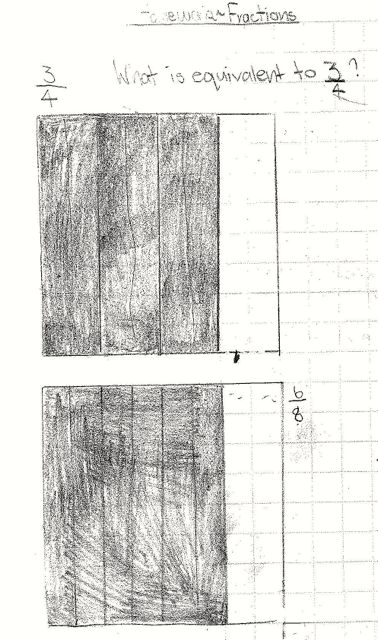
Here are a few examples:


A bit hard to see but it shows 3/4 and 6/8 of a square being equal.


Using a triangle to show that 1/2 = 2/4 = 4/8

Yes, this is true - but are the pictures really showing equal parts?


The hexagon and the octagon were produced by the same Awesome and Adventurous inquirer. He was able to put forward a theory. We called this theory:


Jack's Theory of Making Fractions Out of Polygons


According to the theorist, when you have a polygon, you will definitely be able to divide it into equal pieces with a denominator that is a factor of the number of sides.

He later produced an addendum to his theory to include multiples of the number of sides.

A very interesting exercise.