Tuesday, 6 May 2014

Magic Squares

I had a parent send me a link to a site that has free e-books about maths on it.


I'm always keen on free things (it's the Scottish heritage) so I went and had a look. There was a lot of books that weren't going to be that useful in Year 5 as they were aimed at university level maths. However, I did find several books that really intrigued me. I am interested in old maths text books and there were several from over 100 years ago.

One that caught my eye was called "Magic Squares and Cubes" by William Symes Andrews, published in 1908.


Well, this looked promising. Magic squares are always fun and they can't have changed much in 100 years, since they've been around since Aristotle.

So, looking through, I found some really great examples, some instructions on how to construct magic squares of different sizes, and then this diagram:


Without telling them what they were looking at, I asked my class to find patterns.

Here's what they found:


Lots of numbers increasing by 10 arranged vertically!


If you look carefully you can see that the number under each multiple of 9 is the next consecutive number. For example, under 36 is 37.


And yes we found that every row and column adds up to 369!


And the sum of all columns and rows is 6642, or 18 x 369.


It took a bit of leading to see that this grid had been constructed by using an elongated "knight's move" - four squares to the right and 1 up. 


Alternatively, you could go five squares to the left and one up because there are 9 squares in each row (5+4 = 9). 


Which made the kids think of the globe - you can travel either East or West and you will meet up at the same destination. 


Good thinking!

I wonder what other treasures I am going to find in these old books?


Friday, 2 May 2014

Area and Perimeter Exploration

So we were looking at area a while ago. This led us into a conversation about the properties of 2D shapes. And then we spent some time with perimeter.

Now had come the moment I dread - when area and perimeter collide in the minds of the students and they come away dazed and confused. (How many times have you seen that? Hopefully we had clarified each of the concepts clearly enough.)

Anyway, the time had come to pose a favourite question of mine:


In fact, I wrote a post about this almost 2 years ago.

Here's what we came up with this time:


This group chose to use a hexagon for their example. The perimeter of the yellow hexagon was 15cm. Good stuff.

They found that 2 trapeziums (trapezia?) had the same area as the hexagon but a different perimeter. Well done.


Another group chose to use the Base-10 blocks. They made a 10x10 square (a=100; p=40) and then reorganised the blocks to make a 5x20 rectangle (a=100; p=50).


So just to be annoying, I asked them what would happen if they put all the blocks end-to-end? Same area but what would be the new perimeter? And then if you cut that rectangle in half long ways....


So, everybody happy. Yes - you can have the same area but with different perimeters.

Next question:


Previously I have done this as two separate activities but today we had time and we were on a roll so we kept going.

And here is what the kids came up with:


Happy with this one - nicely set out and very clearly explained.


An interesting solution - not using regular shapes. 
Solves the problem but not a lot of explanation.


Another way to do this.


The post I did 2 years ago that showed this activity was with Year 4 students. This time I am working with Year 5. Not quite as bright and colourful as the younger kids, not quite as diverse in their solutions and somewhat more structured in their presentation of solutions.

Wonder whose expectations have changed - theirs as students or mine as a teacher?


Saturday, 12 April 2014

Do Newspapers Have More Ads than Articles?

We are currently doing an inquiry on "How We Express Ourselves", one of the six PYP transdisciplinary themes. Our focus is looking at how beliefs and values are expressed through advertising.

So naturally we wanted to use maths to help us collect and analyse some data.

Here's what we did.


We started with the provocation that newspapers have more ads than stories. Could this possibly be true? How could we find out? 

At first, students were keen to count the number of ads and compare this to the number of stories. Surely this is what we mean when we say "more".

But they quickly worked out that this would not really be effective - what if there were lots of small ads and only a few big stories, or the other way around?  

Obviously we needed to compare the sizes of the ads and the articles. So how do you do this?

Fortunately, out teacher had been showing us a few things about using multiplication to calculate the area of rectangles. And if you read the fine print under the provocation, you can see the content description from the Australian Curriculum mentions using multiplication to solve problems. Could this be a clue?


So we got out the newspapers and started playing. It was a good conversation - What part is the story? Does it include pictures? Does it include headlines? What is an ad? 


And there were some calculations to add data to the conversation. Good to record the date and page of the "Syndy hereld" for future reference.


Students were encouraged to use coloured higlighters to keep track of each story and ad so that the calculations didn't get confused.


Here's another example of the calculations that were involved.

In Conclusion


I think we ended up with more questions than we answered. We didn't get a definitive solution to the provocation because we decided that:

- different newspapers might be different

- different pages of the same newspaper might be different

- there are lots of little bits that aren't stories OR ads

- sometimes there are whole-page ads with no story. 

- sometimes there are whole pages of small stories without any ads.

Anyway, we had some fun, did some maths and now know that we need to expand our inquiry for next time.

Yeah, next time let's pull apart a whole newspaper and look at the whole thing, not just random pages.

And then we could compare that newspaper with a different newspaper.

And then we could... 


Monday, 7 April 2014

Happy 2nd Birthday!

The blog has turned 2!


The first post on this blog was done on 2nd April 2012. A lot has happened since then, highlights including:


  • The Churchill Fellowship
  • The World Tour of Maths
  • The Maths in Sport series in January 2014
  • Getting a mention from Dan Meyer on his site in February 2013 that put a lot of people into contact with my page
  • Hearing from some amazing people out there doing amazing things, none of whom I have ever met face to face but all of whom I count as friends - including Stephanie Adan, Andrew Blair, Jason Graham, Craig Dwyer...the list goes on!
So, please celebrate with me on reaching this milestone - 2 years of blogging, 75 000 views from 135 countries, 170 posts....and lots of fun!


Tuesday, 11 March 2014

The Laws of Maths - The Associative Law with Multiplication

We're getting close to the end of our time looking at the Laws of Maths (and the kids will be glad to move on to something new).

So, we brought the multiplication process into the Associative spotlight.


Now we were getting into some interesting territory.


Having spent the last two weeks:
1. learning about the Commutative and Associative Laws
and..
2. experimenting with using arrays

...we were now in a place where we could start thinking for ourselves and the teacher could take a bit more of a backseat.

So once again we pulled out the counters and started thinking about the provocation.


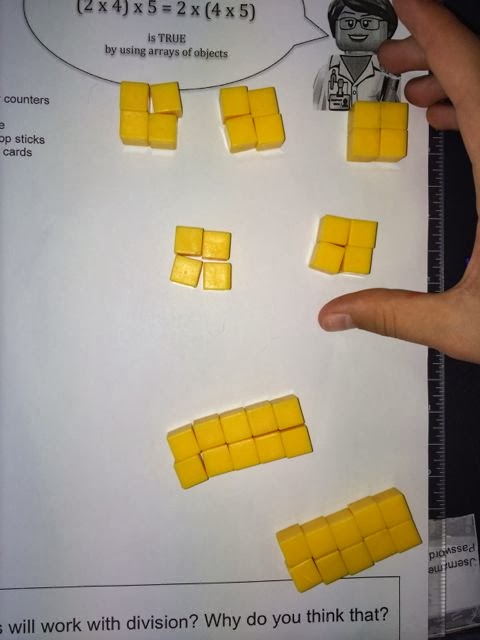
 A nice looking display - at the top we have 5 groups of 4 x 2
and underneath we can see 2 groups of 4 x 5


 So when we put them together we can see that the two groups
are the same. Nice proof.


This one was a bit confusing to me. We've got 4 x 5 at the top
and 2 lots of 2 x 5 at the bottom. Not quite the same as the provocation at the top.


So we reorganised things a bit and had a chat about what we were looking for.
I find these little chats that follow moments of confusion really significant -
helps me to assess and diagnose.


And just when I thought everything was going so smoothly, I came across this
example of someone trying to model the symbolic notation using blocks
rather than making an array. 
Time to reflect on my tuning in process for this inquiry.


Having come this far, we are going to finish with the Distributive Law later in the week.

Can't do it tomorrow because we have "Gruffalo Day"

...but that is another story!


Wednesday, 5 March 2014

Year 2 Addition with Numberlines

This morning I had the opportunity for some quality time with Year 2. I wanted to see what they could do with numberlines. And how they could use them to explain addition and subtraction.

So we started off with a strip of paper that we wrapped around our heads - seemed like the best place to start.

Using the paper strips, we measured the circumference of our heads and then compared to see who had the biggest. Contrary to expectations that the teacher would have the biggest head because (i) he was older and (ii) he had more brains, we found that while my head has a circumference of 57cm, one of the students' heads had a circumference of 61cm.

We compared strips of paper and found that, yes, one was indeed longer than the other. I asked them if they knew a word that would describe that bit of overlap - but couldn't draw out the word "difference" so I had to tell them.

"Oh yeah, we know that," they said.

Next, we had a general chat about how to draw a numberline and then had a go at representing our head data:

57cm + ? = 61cm

This they did (sorry, no photos of this bit) as it was quite an easy calculation to make. The answer (4cm) was never going to be a surprise but I wanted to see them using a known fact before we explored any further.

Then I asked them to use a numberline to show me:

57 + 14 = ?

And so the fun began!

Here is what we came up with...


So, in one jump we go straight from 57 to 71. This is mathematically correct but shows me nothing about using a numberline or the process behind the operation. I asked for more information - and got a blank stare.


Another student started with this idea - what if I jump by 10 straight to 67? But, seeing that space was running out, she wiped out the line and started again...


...to produce this one. Add one jump of 10 and then another jump of 4. Good work!


 But then we had this solution. According to this representation, 57 + 14 = 70. I put it to the group that this one was the correct answer and that 71 was incorrect, which threw them a bit.
"Look!" I said. "There are 14 jumps under the number line. So 57 + 14 must equal 70."
They knew it couldn't be but couldn't see why.


Here's where it gets messy. As the numbers get closer together, there student runs out of room and ends up skipping one of the jumps that he is numbering, so the jump between 69 and 70 is not labelled. Yes - we do need to be careful when construct a numberline. 


So what?


This was just an introductory activity to get an idea of what the Year 2 students understood about numberlines. 

As a result:

1. we talked about some of the important features, such as labels, direction, accuracy and infinity

2. we talked about how to make "provable" jumps, not just blind leaps to apparently random answers

3. we modelled addition on a numberline

4. we laid the groundwork for future explorations using numberlines for other applications

5. we had some fun and I got to meet a few students who I didn't know before. Looking forward to getting back in to see them on a regular basis.


Tuesday, 4 March 2014

The Laws of Maths - The Commutative Law with Multiplication

Our conversation about the Laws of Maths has moved on this week to consider multiplication.

How do the Laws that we have discussed so far apply here?

Let's have a look at the Commutative Law.

Here's what our provocation looked like:


So, after a bit of tuning in that looked like this:


We did the "1 Minute Challenge" and then had a look at the grid.
I find this really interesting and helpful for the kids to get them focused
on what they already know and what they need to learn.
As we go on, they can colour in the tables facts they "master".

And then it was on to the fun and games.

How do you prove the provocation is correct?


So, I was really keen to get the kids to use arrays for this one, partly because I don't think they have used them very effectively in the past and also because they are going to need them when we start talking about the Distributive Law - stay tuned for that one!

When we got started, we decided it might be a good idea to make two arrays: 
one that was 4 x 9 
and the other that was 9 x 4

But were they going to look any different? 

And how could we demonstrate that they are equivalent?  


After a mad scramble for the blocks...


...we found that 9 groups of 4...


...and 4 groups of 9 take up the same space.
Seems obvious but it was really good to see it.


Some groups lined all their blocks up to compare the length and see that it was equal.


Not everything went to plan. Here's a few problems we encountered:


So here we have 4 groups of nine, which is obviously longer than 9 groups of 4... 


A simple problem, but an important one. Yes - you actually need to count accurately when using blocks. These guys got a bit carried away and the 4 groups of 9 included one group of 10 and one of 11.


This one is fascinating. It shows the alert teacher that here are some students who don't get the idea of arrays, don't understand how to use blocks to represent number facts and who missed the point of the activity.

Back to the drawing board...


So we made 9 groups of 4 and also 4 groups of 9...


...and with a bit of reorganising we could see they looked the same!


So what?


It's not rocket science, I know, but having done this activity...

1. we can now construct an array

2. we can demonstrate the Commutative Law as it applies to multiplication

3. we can see what we are talking about (abstract idea made concrete through modelling)

4. we all now know that 4 x 9 = 36

5. ...and we got the blocks out and had some fun.