Friday, 28 July 2017

Squares and triangles - Part 2

The day after we played with the "counting by 3's" pattern, I was keen to push on further.

Sometimes "lessons" seem to go longer than 45 minutes. I could see this one was going to take a few days.

Make a square pattern

When the kids come into the room each morning, they are greeted with a pattern challenge.

"Make a square pattern," said the sign on the white board.

So here is what they did.


This is not quite what I had in mind but we never throw away a student's attempt - there is always fertile ground to explore. I hadn't said anything about "area" or "perimeter" or what I expected the square to look like. So this was an interesting conversation piece. Even though we were not going to pursue this type of square. I wanted to direct the thinking towards arrays.


Interesting. A nice square array (6x6) showing how (6x6) can be made up of 9 lots of (2x2).


Lots of squares in evidence here. 


A nice sequence from (1x1) up to (6x6).


This is nice. Can you see (1x1)? (3x3)? (5x5)? (7x7)? And why is it the odd-numbered squares? 


Then I asked the students to draw their squares and write about them. This example is pretty exception for a Year 2 student. 

So we started to look at the pattern of square numbers. An interesting conversation but one I left hanging - I wonder what the next square number is? And the one after that? And the one after that?

The Next Day

Before I had a chance to say anything the next morning, two different students handed me their workings for all the square numbers up to 10x10 (Student A) and 12x12 (Student B). They had both decided to see where the pattern went.

Squares and Triangles

As students came into the room on Day 3, they found a challenge question: "Can a square be made up of two triangles?"

And now we came to the exciting bit where I stepped back and watched what they would do. Would they use any of their previous experience from the previous two days to tackle this question.

I already knew that a square number is the sum of two triangular numbers. But I wasn't about to tell them that. I wanted to observe the thinking.

Here is what unfolded.


Everybody rushed into making triangles. Lots of good looking triangles. Lots of pairs of identical triangles. But we just couldn't get them to fit these triangles together to make a square!

(Hence, probably demonstrating that the two triangular numbers you add together to make a square number need to be different)

It was decided - this myth was busted! No, you cannot make a square out of two triangles.

I finally intervened.

"Hang on - check out the question again. Instead of starting with the triangles, what if you started with the square first?" I asked.


But once again the answer was definitive: you cannot make two triangles out of a square unless you want to cut some counters in half.

Then there came that beautiful moment in teaching, when one lone, brave wavering hand is raised by the shy girl towards the back.

"I..I..think you can..."

It was so simple. Here is her diagram:


And her explanation:


Yes - you can divide the square into two triangles - all you have to do is "miss" a bit to one side of the diagonal and draw your cutting line just in between the counters in the array.

That teaching moment was the highlight of my week. 


Wednesday, 26 July 2017

Squares and Triangles - Part 1

Throughout the year, I have been using Jo Mulligan's "Patterns and Structure Mathematics Awareness Program" (PASMAP) as a resource to stimulate some direction in my maths inquiry with Year 2. It is a great initiative that brings a clear focus onto the significance of spatial reasoning in all areas of mathematics education. The kids love it.


This is Book 2 for Years 1 + 2.
Do yourself a favour and get a copy.


We have spent a lot of time playing with patterns. I wanted to explore the link between the pattern and the numbers behind it. This exploration was going to be related to some of the PASMAP ideas, so I can't take credit for them but I think we explored a few interesting related ideas as well.

This "lesson" or "sequence" went over about 4 days. It started with a counting pattern. It ended up looking at the relationship between square and triangular numbers.

This is going to take a few posts...

Counting by 3's


Anyway, we started off looking at what happens when we count by 3's. This is a good pattern to look at because it is slightly more difficult than counting by 2's or 10's but not so difficult as to be out of reach.

So I asked the students to show a counting by 3 pattern using our favourite Cuisinaire rods. Here is what they produced:


Using the light green as 3, this is a nice representation of what happens when we count up by 3.
Notice the outline of the pattern is starting to look like a triangle...


We did start to run out of light green rods so this student did some interesting substitutions:
i) using a red/white combination to replace the light green
ii) using the dark green to represent 2x light green
This student is showing both additive and multiplicative thinking - great fluency!


A-ha! The triangle shape is starting to emerge!


Definitely a triangle...


Exploring the Counting by 3's Pattern


As mentioned, I wanted to take the conversation deeper and to get the students to start thinking about representing the pattern using numbers. 

The PASMAP program encourages a pedagogical model based on five components:

1. Modelling
2. Representing
3. Visualising
4. Generalising
5. Sustaining

We were heading into the "Representing" phase.


The "Zero Row" - an important aside


During the recent holidays, I attended the AAMT national conference in Canberra (Actually, we were hosting it). Several times during the week, I heard speakers refer to the "zero row" - the very first step in a pattern. 

So of course, when we started talking about the counting by 3's pattern, this was where we had to start.


Representing the Pattern

Talking through what we had made on the floor, I asked the students to describe each level of their pattern. The pattern itself was not a new one - they had seen it before - but I was interested in seeing what it would reveal.

We came up with this representation:


Firstly, I used some Unifix cubes and some Blutack to show the pattern on the whiteboard.

Column 1: the representation
Column 2: number of groups
Column 3: how many in each group
Column 4: total number of cubes

Yes - we included the zero row.

Then I asked, "Are there any mathematical symbols we could put in between the numbers to make number sentences?"

"Yes - we could put a plus sign!"

Really? Well we tried it and guess what? It didn't work.

So, next guess?

"We could do a times sign, like 2 times 3 equals 6."

So we gave that a go. Note that we were happy with 2 x 3 and above but didn't want to commit to 1 x 3 or 0 x 3. 

Yet.


By working backwards, we were able to use the pattern and agree that 1 x 3 = 3 and that 0 x 3 = 0.


"Can we see any more patterns in there?" asked the annoying teacher, not satisfied with the hard work the students had put in.


Anita Chin's fabulous "Make it, say it, draw it, write it" magnets on the white board

So we wrote out the counting by 3's pattern up to 51. Then we looked at what we saw:

- there are 4 numbers less than 10
- there are 3 numbers in the 10's, 3 numbers in the 20's
- then back to 4 numbers in the 40's etc
- the units pattern goes 0, 3, 6, 9, 2, 5, 8, 1, 4, 7 and back to 0
- the pattern goes odd, even, odd, even

Using these patterns, I speculated about what numbers we would find after 51, without needing to actually count by 3's.

Here is what we predicted:
- the number after 51 will be even
- there will be 3 numbers in the 50's
- 60 will be the next number to end in a zero

The I asked, "Did you notice that numbers in the pattern can be reversed and the new number they make is also in the pattern? Try 15 - reverse it and you get 51. 24 becomes 42. 21 becomes 12."

I wonder if that is always true?


Wednesday, 21 June 2017

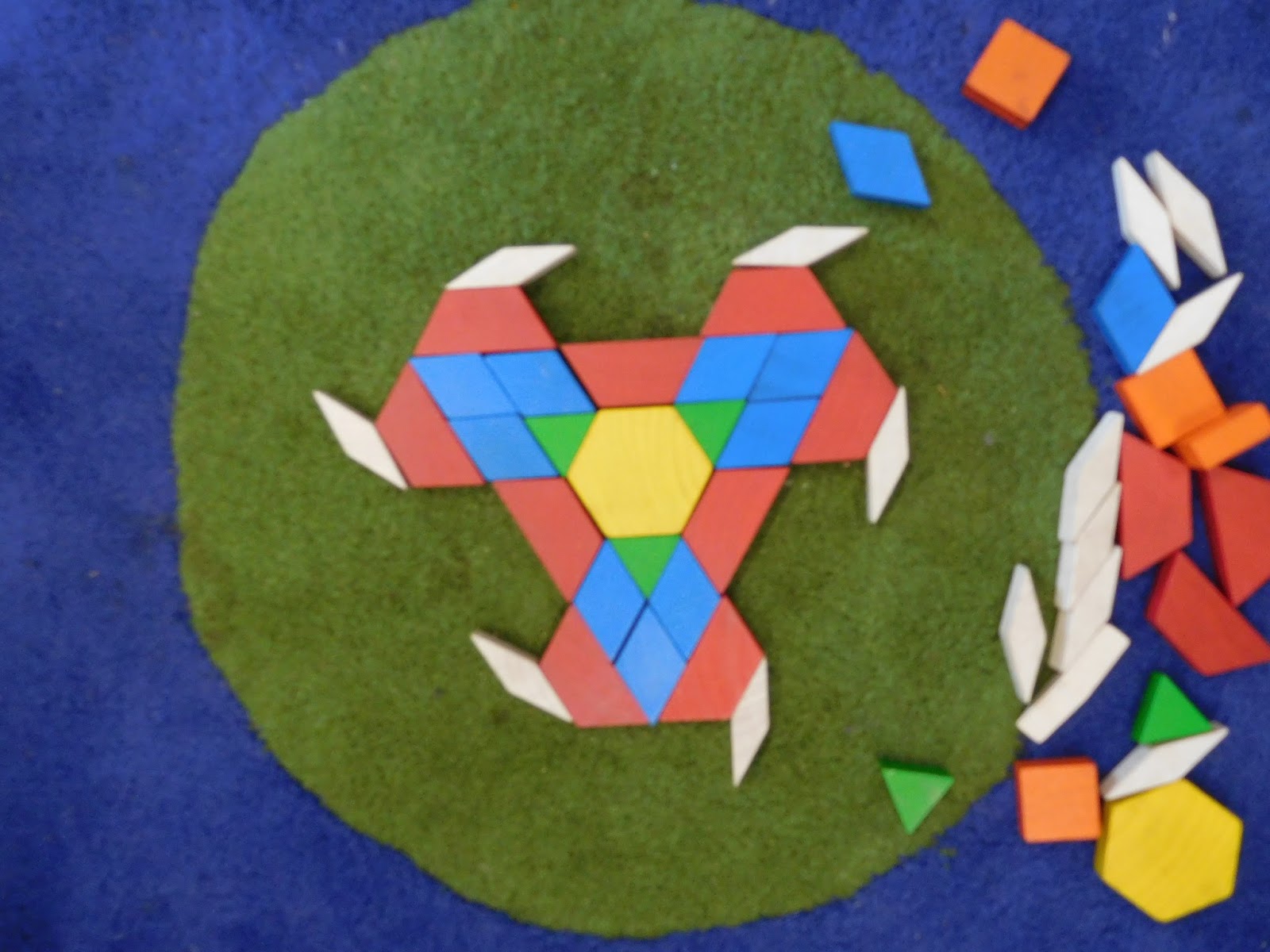
Patterns Inside a Circle


We are very lucky at our school to have some great resources.

Some of these may not be so obvious - like the big circle rug on the floor in my room. I decided today that we would use this rug as the base for our patterns.


So when the kids came in, they found I had put some materials in each circle. Some had pattern blocks, some had Cuisenaire rods.


The challenge - make a pattern inside the circle using the materials provided.

Here is what the kids came up with:


Linear Patterns


Bilateral Symmetry


Rotational Symmetry


Interesting the way the kids went about this. Some took quite a while to settle on an idea. Others made several patterns. A few wanted to make pictures - the Mona Lisa, a dog, even the clock was a bit "pictorial" before I probed a bit about the need to make a pattern.

There was very little copying - or "piggy-backing" on the ideas of others. Most of the students had their own creative solutions they wanted to explore. 

I was very interested to use this a bit of an assessment moment - how far had we got in two terms? 

Results - I was impressed at the spontaneity and individuality of the students. I saw examples of different types of patterns that we had explored already. I was also able to identify a few individuals who struggled to come to terms with the task.

This is our last week before the mid-year break. See you sometime in July.

Oh - and if you are coming to the AAMT conference in Canberra, come and say hello.


Thursday, 1 June 2017

Numbers under the pattern - the kids take control


I followed up the previous task (Numbers under the pattern) by handing over a bit to the kids.

Rather than use patterns that I had made, I gave them blank 5x5 grids and asked them to create their own number patterns, then cover them using the coloured cubes as before.

They could start at any number and count up by any number.

And they did.

Here are a few examples of counting patterns these guys chose, some recognising that a calculator is a great tool for this purpose:


- Counting by 17 pattern:


- Counting by 260 pattern:


- Counting by 562 pattern


- Counting by 8476 pattern:


- Starting at 193 and counting on by 162:


This was pretty good stuff from Year 2 kids. So good that they didn't actually get to the other part of the activity, that was placing the coloured cubes on their patterns.

Kids who chose a simpler number pattern for their grids did however move forward to the next part.

Here is what we found:

- If you start with even numbers and then add on even numbers, you end up with some pretty vertical looking patterns.

- If you use odd numbers, you are likely to find some sort of grid pattern - maybe odds and evens.


Can you guess which pattern might have only even numbers and which might involve odd numbers?


So...top pattern is counting by 2's and is only even numbers.
Bottom pattern is counting by 5's.
This student is looking at the pattern made by the digits in the units column.


And again - can you make a prediction about what you might find under the pattern?


So, my guess for this one is that it is something to do with odd numbers.


And I was correct. This student decided to count by 10's, putting down a yellow cube if the 10's digit was odd, blue if the 10's digit was even and red if the 10's digit was 7 or 9.


And then we had this one:


Any ideas? Then let me show you a few numbers...


Hmm...counting by 7's....


Yep - when you count by 7's, the units make a pattern that repeats after each 10th number in the series.

I wonder if that works for other numbers?

I wonder if it works for every number or just for odd numbers?

I wonder....