Monday, 10 November 2014

Playing with Probability

Having started the conversation about probability, I was keen to push on and get our hands dirty with a bit of investigation.

First thing we looked at was rolling dice. Each number has an equal chance of being rolled. How would this play out with 100 rolls? And then if we added the 100 rolls from 24 students?

So we got to work. Would the numbers come out evenly?

Here's some data recording:
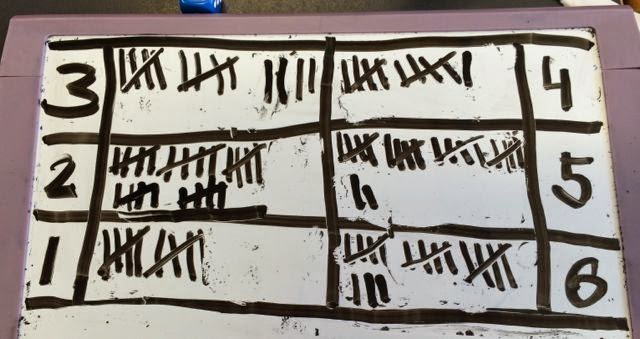


 This one looked a bit random - the numbers are in a strange order -
but it works.


 A bit untidy but you get the idea.
So, did you record 100 rolls? Let's see if that adds up...


 Don't you just love girls? They are soooo organised!


 And once we had data, we needed to display it as a graph so that we could see our data clearly:


Yep - beautiful presentation, accuracy, colour, neatness...

So we then combined all our data and put together the results on Excel.

You will notice that 24 students rolling a dice 100 times each gave us a total number of dice rolls of .... 2419?


Much discussion followed about why we got these results. Why weren't they all even? Why was "3" so low? Why was "2" so high? How could we do it differently?


 Next we made some spinners. This was a bit of fun. Simple to make as well.

I printed off some hexagon shapes which we stuck onto cardboard, coloured in different ways (one spinner unequal chances, one spinner equal chances, one free choice) then stuck through a tooth pick.


You will notice that 24 students rolling a dice 100 times each gave us a total number of dice rolls of .... 2419?


Much discussion followed about why we got these results. Why weren't they all even? Why was "3" so low? Why was "2" so high? How could we do it differently?


Next we made some spinners. This was a bit of fun. Simple to make as well.

I printed off some hexagon shapes which we stuck onto cardboard, coloured in different ways (one spinner unequal chances, one spinner equal chances, one free choice) then stuck through a tooth pick.


 Here's the template we used


Here's what mine looked like


 The kids were so much more creative than me...


 And then we had to invented some games of chance. Here's a few action shots of games in progress:


And a lot of fun was had by all.

It's simple. It's easy. It relates to the Australian Curriculum:

List outcomes of chance experiments involving 
equally likely outcomes and represent probabilities 
of those outcomes using fractions (ACMSP116)

 All good.


Friday, 7 November 2014

Simple Probability

We've started doing some probability work this week - (hmmm... just "happen" to do probability to coincide with Melbourne Cup week - what are the chances of that?).

As ever, we spent some time looking at the language of probability. I was keen to hear what the kids would say about the words we use to describe chance. 

We started with a continuum from 0-1 and placed a few words on the line where we thought they would go.


It looked a bit like this.

And some close ups:


Then we talked about the meanings of the words and how they related to chance.

Here's a few of the comments the kids made:


It is impossible, certain and 50-50 or half.

When there’s an even amount of choices and an even amount of things in that choice then it’s impossible to predict which one it will be.

There’s a lot of words for 50-50.

Halfway between impossible and certain there’s an even chance of it not happening or happening.

There’s always chance in whatever you do. If you’re kicking a footy there’s a chance that it will go to whoever you’re kicking it to or not.

There are different words for impossible, certain and half because they’re also things in between those.

In probability there are fractions involved. You can’t go over the 1 point.

Buckley’s means “no chance”.

Almost everything we do in life has a bit of chance.

I don’t think there are things that are certain or things that are impossible.


So, language is always a good place to start. We were able to assess prior knowledge, explore a few new ideas a little bit and generally get the ball rolling. It also gave us some direction for where we would go next.


Sunday, 19 October 2014

I can't do this...yet!

You've probably read the many articles and pages written about the power of "Yet" - adding this small word to the end of "I can't do this..." make so much difference.

(Check out Carol Dweck on TedX or Janelle Monae on Sesame Street for starters.)

So I thought I'd make it real in my classroom. 

I printed out a stack of tags that look like this:


It's a Yeti - saying "...yet!"


The idea is for the kids to reflect on their work and if there is something they don't understand (yet) they can get one of these tags and glue it next to their work.

Very popular. I was overwhelmed by the response of the kids. Even those who I think really did understand, wanted to put one in their books!

So I have now made a second tag:


This is for when you DO understand what you are doing, when you do "Get it" and can demonstrate your understanding.

Reflection is such a powerful tool for learning.


Monday, 22 September 2014

Maths in Year 6 Exhibition 2014

Last week our Year 6 classes did their PYP Exhibition. It was amazing. Such a great opportunity for the kids to celebrate their journey through the PYP.

I am always keen to see how they will use mathematics. They never disappoint me with the creative ways they look at things.

So here are a few precious examples from last week.


The first thing I noticed was some clever use of infographics. The kids had been shown the Piktochart website and ran with it. Here are a few nice examples:


This group used an infographic to present results from a survey they did to find information about technology use and addiction.


 This group used their infographic to present information they found in their research


Other groups used "live" surveys to ask visitors to answer a question. They found some great ways to present their results that they built up over the Exhibition period.


This group was asking a big question about racism in sport...


 ...and they got respondents to place a pin with a football into the pitch to show their answer.


 The question of what to do with refugees - voting by marbles.


 I really liked this one. You got to put your vote in the balance scale and each ping pong ball had a positive message written on it.


This was a fund way to vote - and the kids loved it.


This called for a tough decision - which is a more significant problem: child soldiers or post traumatic stress disorder in returned service personnel?


The votes were cut into leaf shapes to represent a "tree of hope".
 
 
So once again I was very impressed. I hope you enjoyed seeing what the kids came up with.


Thursday, 18 September 2014

This Week in Fractions

This week we planned to do "Fractions".

I know - stand alone content taught out of context.

So I shook it up a bit and made a website full of lots of fun activities.

Here it is. Hope you enjoy looking at it.


Wednesday, 17 September 2014

Finding Area Using Arrays

I was working with Year 2 the other day. They were keen to do some work with arrays to look at multiplication. I was keen to make it a bit of fun.

So, I thought, lets put the array thing together with some shapes that we need to find the area of.

I constructed the following set of shape outlines:


Then I asked the kids to find the biggest one and the smallest one. Fortunately I had made the sides of all the shapes whole centimetres, suggesting to the kids that they could use Base 10 blocks to work out the area of each shape.

(Just to be tricky, I made the task a bit ambiguous - there are several shapes that all have the same area - some are big and some are small. I wanted to see what conversation would come out of that.)

And here's what they did:


So we can put the Base 10 blocks onto the shapes to find how many cover it.


This one looks really big - it's soooo long!


Might need to use some units and well as tens.


Hmm, several of these are 24 square cms.
But why are they hanging over edge of the shape? asks the teacher.
Well, there's 2 hanging over so it must be 8 long (10 - 2 = 8) so 3 x 8 = 24! says the student.


And same again! 10 - 4 = 6. 
So 4 x 6 = 24.


Smart kids! It's easier (less fiddly) to use the 10 blocks than getting all the units blocks out.

And yes, they were doing multiplication and arrays and area all in one go.


Saturday, 13 September 2014

Making Tetrahedra

I was at the Canberra Maths Association conference a few weeks ago and saw this really simple idea from Maria Quigley from the University of Sydney.

When making models of 3D objects, Maria used those really jumbo sized plastic straws you get at some "bubble tea" outlets. They are useful because you can pass a string through the straw (several times if needed) and tie your shapes together.

So I had a go in my classroom. I bought a few packs of these straws, which are available pretty cheap at some $2 shops. We all sat down and had a go at making a tetrahedron. Here are a few of our results:


Note - collaboration; when we work together we learn so much more. 


They all looked pretty good when I hung them up.


But of course I am an annoying teacher. I wasn't prepared to let it rest at that.

So I started asking some questions.

"What if....?"

"And if we got 2 of them and....?"

"And could you...?"

And suddenly the kids were making some discoveries, like:

"Hey, I can't make this cube stay up."

"Is this a triangular prism?"

"What do you call this shape when you put two tetrahedra together?"


And then they started to construct models of objects I had no idea what to call. 

This is how we learn.