Showing posts with label Area. Show all posts

Wednesday, 17 September 2014

Finding Area Using Arrays

I was working with Year 2 the other day. They were keen to do some work with arrays to look at multiplication. I was keen to make it a bit of fun.

So, I thought, lets put the array thing together with some shapes that we need to find the area of.

I constructed the following set of shape outlines:


Then I asked the kids to find the biggest one and the smallest one. Fortunately I had made the sides of all the shapes whole centimetres, suggesting to the kids that they could use Base 10 blocks to work out the area of each shape.

(Just to be tricky, I made the task a bit ambiguous - there are several shapes that all have the same area - some are big and some are small. I wanted to see what conversation would come out of that.)

And here's what they did:


So we can put the Base 10 blocks onto the shapes to find how many cover it.


This one looks really big - it's soooo long!


Might need to use some units and well as tens.


Hmm, several of these are 24 square cms.
But why are they hanging over edge of the shape? asks the teacher.
Well, there's 2 hanging over so it must be 8 long (10 - 2 = 8) so 3 x 8 = 24! says the student.


And same again! 10 - 4 = 6. 
So 4 x 6 = 24.


Smart kids! It's easier (less fiddly) to use the 10 blocks than getting all the units blocks out.

And yes, they were doing multiplication and arrays and area all in one go.


Friday, 2 May 2014

Area and Perimeter Exploration

So we were looking at area a while ago. This led us into a conversation about the properties of 2D shapes. And then we spent some time with perimeter.

Now had come the moment I dread - when area and perimeter collide in the minds of the students and they come away dazed and confused. (How many times have you seen that? Hopefully we had clarified each of the concepts clearly enough.)

Anyway, the time had come to pose a favourite question of mine:


In fact, I wrote a post about this almost 2 years ago.

Here's what we came up with this time:


This group chose to use a hexagon for their example. The perimeter of the yellow hexagon was 15cm. Good stuff.

They found that 2 trapeziums (trapezia?) had the same area as the hexagon but a different perimeter. Well done.


Another group chose to use the Base-10 blocks. They made a 10x10 square (a=100; p=40) and then reorganised the blocks to make a 5x20 rectangle (a=100; p=50).


So just to be annoying, I asked them what would happen if they put all the blocks end-to-end? Same area but what would be the new perimeter? And then if you cut that rectangle in half long ways....


So, everybody happy. Yes - you can have the same area but with different perimeters.

Next question:


Previously I have done this as two separate activities but today we had time and we were on a roll so we kept going.

And here is what the kids came up with:


Happy with this one - nicely set out and very clearly explained.


An interesting solution - not using regular shapes. 
Solves the problem but not a lot of explanation.


Another way to do this.


The post I did 2 years ago that showed this activity was with Year 4 students. This time I am working with Year 5. Not quite as bright and colourful as the younger kids, not quite as diverse in their solutions and somewhat more structured in their presentation of solutions.

Wonder whose expectations have changed - theirs as students or mine as a teacher?


Saturday, 12 April 2014

Do Newspapers Have More Ads than Articles?

We are currently doing an inquiry on "How We Express Ourselves", one of the six PYP transdisciplinary themes. Our focus is looking at how beliefs and values are expressed through advertising.

So naturally we wanted to use maths to help us collect and analyse some data.

Here's what we did.


We started with the provocation that newspapers have more ads than stories. Could this possibly be true? How could we find out? 

At first, students were keen to count the number of ads and compare this to the number of stories. Surely this is what we mean when we say "more".

But they quickly worked out that this would not really be effective - what if there were lots of small ads and only a few big stories, or the other way around?  

Obviously we needed to compare the sizes of the ads and the articles. So how do you do this?

Fortunately, out teacher had been showing us a few things about using multiplication to calculate the area of rectangles. And if you read the fine print under the provocation, you can see the content description from the Australian Curriculum mentions using multiplication to solve problems. Could this be a clue?


So we got out the newspapers and started playing. It was a good conversation - What part is the story? Does it include pictures? Does it include headlines? What is an ad? 


And there were some calculations to add data to the conversation. Good to record the date and page of the "Syndy hereld" for future reference.


Students were encouraged to use coloured higlighters to keep track of each story and ad so that the calculations didn't get confused.


Here's another example of the calculations that were involved.

In Conclusion


I think we ended up with more questions than we answered. We didn't get a definitive solution to the provocation because we decided that:

- different newspapers might be different

- different pages of the same newspaper might be different

- there are lots of little bits that aren't stories OR ads

- sometimes there are whole-page ads with no story. 

- sometimes there are whole pages of small stories without any ads.

Anyway, we had some fun, did some maths and now know that we need to expand our inquiry for next time.

Yeah, next time let's pull apart a whole newspaper and look at the whole thing, not just random pages.

And then we could compare that newspaper with a different newspaper.

And then we could... 


Thursday, 21 November 2013

Find the area of a circle......without using pi

I haven't had much time to write on the blog lately as we are busy assessing and writing reports. Don't you love end-of-year?

As part of the assessment process, we used a pencil and paper test to confirm what we were thinking about Maths skills and concepts.

We had done a bit of inquiry into find the area of 2D shapes with straight sides. We hadn't looked at circles.

So I thought I'd throw in a question about finding the area of a circle. I knew that some of the kids knew the formula so I made the rule that they were not allowed to use pi in any of their calculations.

Just wanted to see what they would do.

So here is the question:

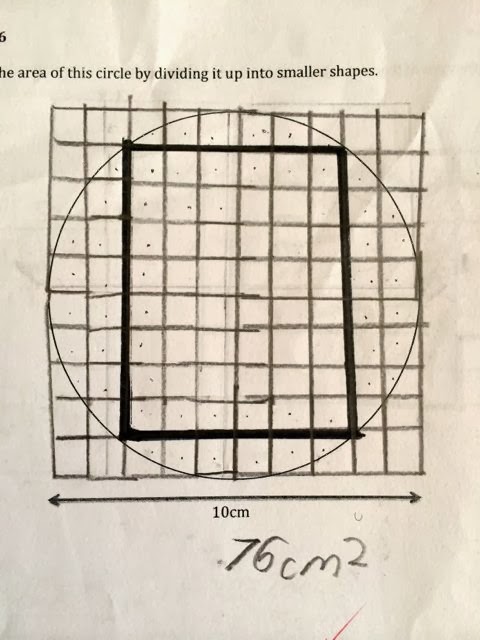
You are given a circle with a diameter of 10cm. Find the area of the circle by dividing it up into smaller shapes. (Do not use pi in any of your calculations.)

(I cheated - I used pi and got an area of about 78.54cm2..  I wanted to have some "real" value to assess the accuracy of the students and their methods against.)


And here a some of the solutions that the kids came up with...


Method 1 - Break it up


Nice idea. Using regular shapes such as squares and rectangles, we can get an approximation of what the area of the circle might be. It is a bit complicated in that it involves lots of different calculations, but the solution presented here was pretty close to our target.


Same strategy but choosing different shapes. This attempt is a bit less detailed so it loses a bit of accuracy but the end solution is also pretty close to out target. The students quickly saw that since the shape is symmetrical, some of the calculations only need to be done once then multiplied by the number of times that shape appears in the diagram.


Method 2 - Subtract the corners from a bigger square


Seeing that the circle has a diameter of 10cm, it would fit into a square with sides 10cm x 10cm. We could then subtract the "corner" triangles to get an approximation. I'm not sure that the student measures and calculated the triangle accurately as their solution was a bit out but the strategy and process was excellent.


Same general idea but this time using rectangles in the corners instead of triangles. 


Method 3 - Using a grid


This student drew up a 1cm grid and used this to count the number of squares. They worked out the number of complete squares and then added half the number of incomplete squares to get a pretty accurate result.


Using a grid for a quarter of the circle means you only have to count a quarter of the number of squares to calculate an approximate area that is very close to our target.


And finally, this student chose to use a 4cm grid to get their solution which was slightly higher than the others but definitely demonstrated a good understanding of the problem and what to do to solve it.


Not everyone got a solution to this question. Several were not sure what to do or failed to use their knowledge to calculate accurately and as a result their solution were way out. 

But all of this provided some useful information - either confirming what I already suspected about each student or giving me an insight into the way they thought.

So....back to the report writing!


Thursday, 31 October 2013

How Big Is Your Classroom - Part 2

So we spent some time collecting data from the P-4 classrooms. This is a bit of a journey thanks to the way our school is set up. P-4 are over one the western boundary of the school - about 250m from Year 5 + 6.


Data Collecting


When we got back we pooled out data. Here is what we found:

Room              Side 1              Side 2               Area


PK                   9.82m            8.51m             8356.82m2
PK                  not measured           
MH                  8.95m             9.25m             82.7875m2
KM                  not measured
1JH                  9.63m             8.2m               78.963m2
1RB                 10.5m             8.0m               84m2
2PM                10.49m           8.5m              
2AH                 9.85                8.0m               78.88m2
3BR                 32FEET          27FEET         
3EB                 8.0m               10.4m             83.20m2
3TM                10.64m           8.1m               86.9288m2
3HB                 8.14m             9.02                73.4228m2
4RB                 8.0m               9.7m               77.6m2
4CS                 10.58              7.75m             81.995m2
4JG                  8.94m             8.9m               79.566m2


Some interesting points:

  • looks like there was trouble with decimal point in one of the PK classrooms - unless their room is actually the size of a football field.
  • One of the Year 4 rooms was missed out. Not sure why.
  • The group measuring 3BR measured in feet and inches. One of them said, "So is there like 30cm in 1 foot so I could try to figure it out that way?" The teacher prompted them to just turn the tape over and use the metric scale that was on the other side.
  • Lots of kids struggled with converting from metres to cms - need to go over that one again.
  • And also the need to take about square centimetres when discussing area.
  • We had a good talk about why the rooms are not all exactly the same. What things were done differently that might account for diversity of responses. And if we all got different results, what statements can we make about this data? Is it fair to say that all the rooms are about 80 square metres? And what room should Mr Black have?


So what?


In a recent chat on #pstchat, a weekly time on Tuesday evenings at 7.30pm EST, I was discussing listening as an assessment tool in maths. An interesting question came up - do the parents think that this kind of assessment is "soft"? Does sitting around listening to kids talk about their actions constitute rigorous assessment? Is it as valid as a pen and paper test?

Here's my response:


  1. If I listen to what the kids are saying as they explain how the went about solving a problem, I will learn more than I would if I just looked at written responses on a page.
  2. By listening, and discretely probing with questions, I can get the students to think deeper than they will if they are just writing answers in a box.
  3. By giving the students the chance to talk about what they have done and to explain the process, I am letting them develop a deeper understanding of the concept that they are engaged with.
  4. There are many students who are disenfranchised by poor literacy skills - their opportunities to progress in Maths are limited because they cannot read or write effectively. These children need to communicate their understanding through talking.
  5. By talking with the whole class, children can gain a broader understanding of the concept by hearing what other students have done.
  6. From this activity that we have engaged in this week, I have been able to modify my teaching (I won't be using tape measures with imperial measurements again), reinforce skills that students were struggling with and clarify concepts that were not fully understood.
  7. I also have a good idea of who can do what - I have notes on individual children and what they said and did. This is qualitative assessment.
So many positives.

And of course we had some fun.


Saturday, 27 April 2013

Finding Area By Combining Shapes

I have been visiting Aoki-Chuo school in Kawaguchi, Japan this week as part of the "World Tour of Maths".

It has been an amazing experience. I have been treated like a rock star. The staff and students have been so friendly and helpful. What a great school!


Cut To The Chase


Anyway, one of the lessons I was watching involved Year 6 working out the area of shapes by looking at the shapes they are made up of.

Now, we are not talking about two triangles make a square here.

We are looking at finding an area like this:


Problem Solving the Japanese Way


One of the things I was seeing in Japanese classrooms was the way the students were encouraged, even expected, to find multiple ways to solve a problem.

Here are four ways that one student demonstrated that found the area of the shape:


Method 1


He works out that a quarter of a circle overlapped on another quarter circle makes the required overlapped shape.

So he calculates that two quarter circles have a combined area of 157cm2.

If you subtract the area of the square, you will have the overlapping shape remaining.

157cm- 100cm= 57cm2.


Method 2


In this one, he works out the area of the entire circle, subtracts this from the area of the bigger square and gets the area of the four corner pieces. This he divides by 4 to get the area of one corner piece. Then he multiplies by 2 and subtracts this total from the area of the smaller square to get the required solution.


Method 3


This time he uses a triangle and sees that the difference between the area of the triangle and the area of the quarter circle will give him half of his required shape. 


Method 4


His final method is to subtract a quarter circle from the square to get the outside corner piece. This he doubles and then subtracts from the square to get the internal shape.


What next?

Well, after they had time to work independently on their solutions, the teacher selected a few students to come and present their ideas to the class. The presentation is a very important part of the lesson and the children take it very seriously. The get a few minutes to draw their solution on some A3 paper and then stand up and talk about it. At the end they say something like, "This is what I have found to be true." and the class responds, "I agree." Then they ask for any questions, which they answer. Then they are thanked by the teacher and get a round of applause from the class.

After all the selected children had presented their solutions, the teacher left their diagrams on the board and asked the class to find similarities and differences between the various methods. This was important because the final step was to make a generalisation, a statement that could be used to help solve similar problems in the future. It is like the class summarising their learning for the lesson.


So what?


I was blown away. In the space of 45 minutes the class answered one question.

It wasn't 57 different questions from the textbook. It was one question.

But the depth of learning was very impressive. 

And at the end of the lesson, the purpose was manifestly clear - it was all about thinking.

Quality not quantity.


Friday, 19 April 2013

Divide a Square in Half

Some time last year, I got my Year 4 class to divide a square in half and see how many ways they could do it. We had a lot of fun.

So there I was sitting in my first session at the National Council for Teachers of Mathematics (NCTM) conference in Denver this morning. 

The session was titled "And The Area Is...Because!" and the presenters were Kathleen Fick and Nicola Edwards-Omolewa.

The session was fantastic. I loved it.

And the first activity set the pace. 

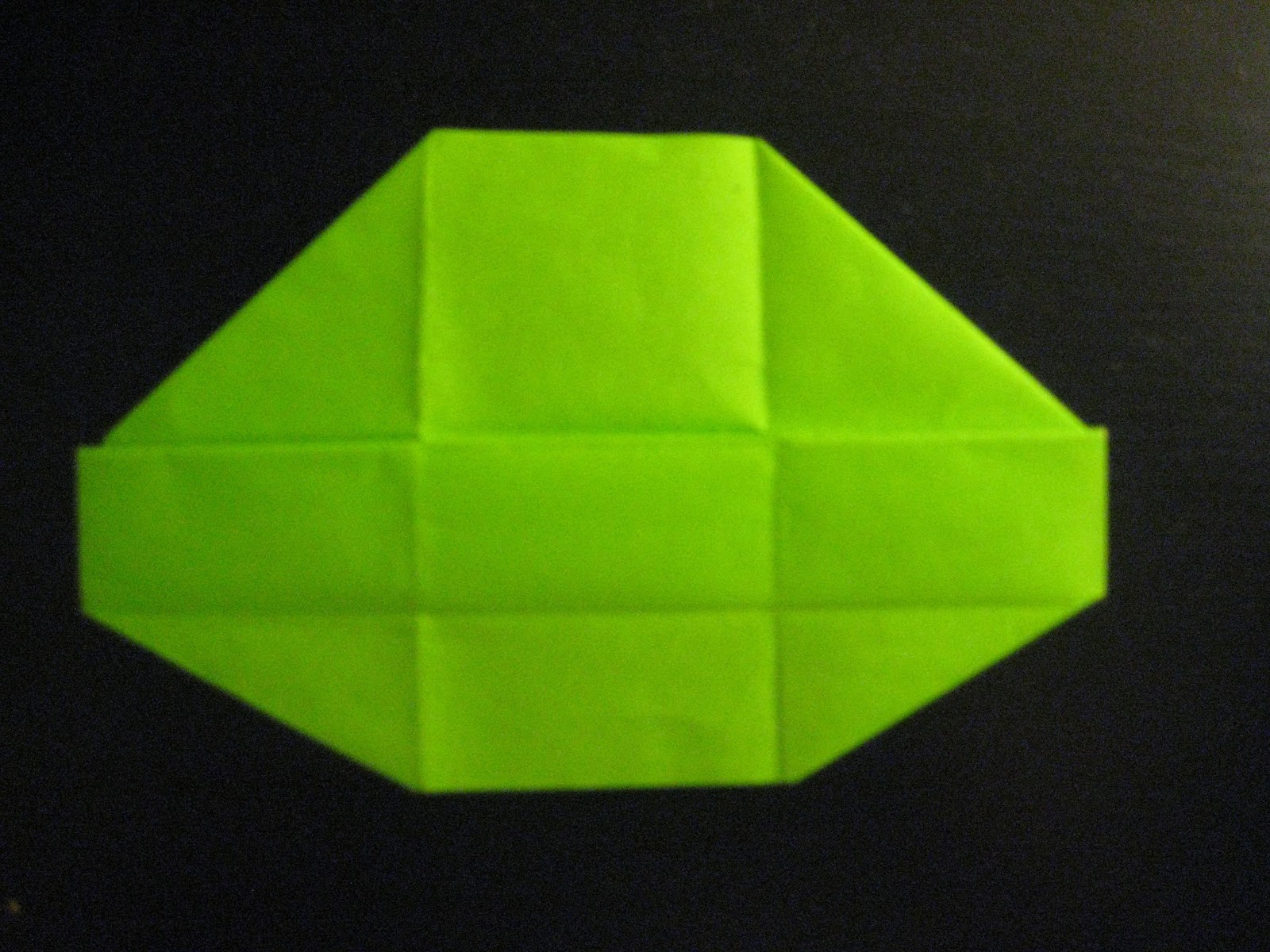
We were given pieces of paper - origami squares - and asked to fold it in half.

How hard could that be? And how many ways could there be?


Here are some of the ways 

- I'm sure there are more!


See how many you can work out!


Here is the original origami square - you can see some of the folds I used for one of the shapes.


Here is a hexagon - the fold lines might help you see how it is half of the original square


The house - simple yet effective


Square - explain this to the kids in terms of fractions of the whole!


An octagon - not regular which I find annoying - I'm still working on a regular one


The kite - very nice combination of triangles


Isosceles triangle - very nice


Parallelogram - hint: the two short sides were edges of the original square


Trapezoid - this one my 4th graders showed me last year. 
As one of the boys said, "Any straight line that goes through the middle of the square will cut it in half!"