Showing posts with label Assessment. Show all posts

Wednesday, 21 June 2017

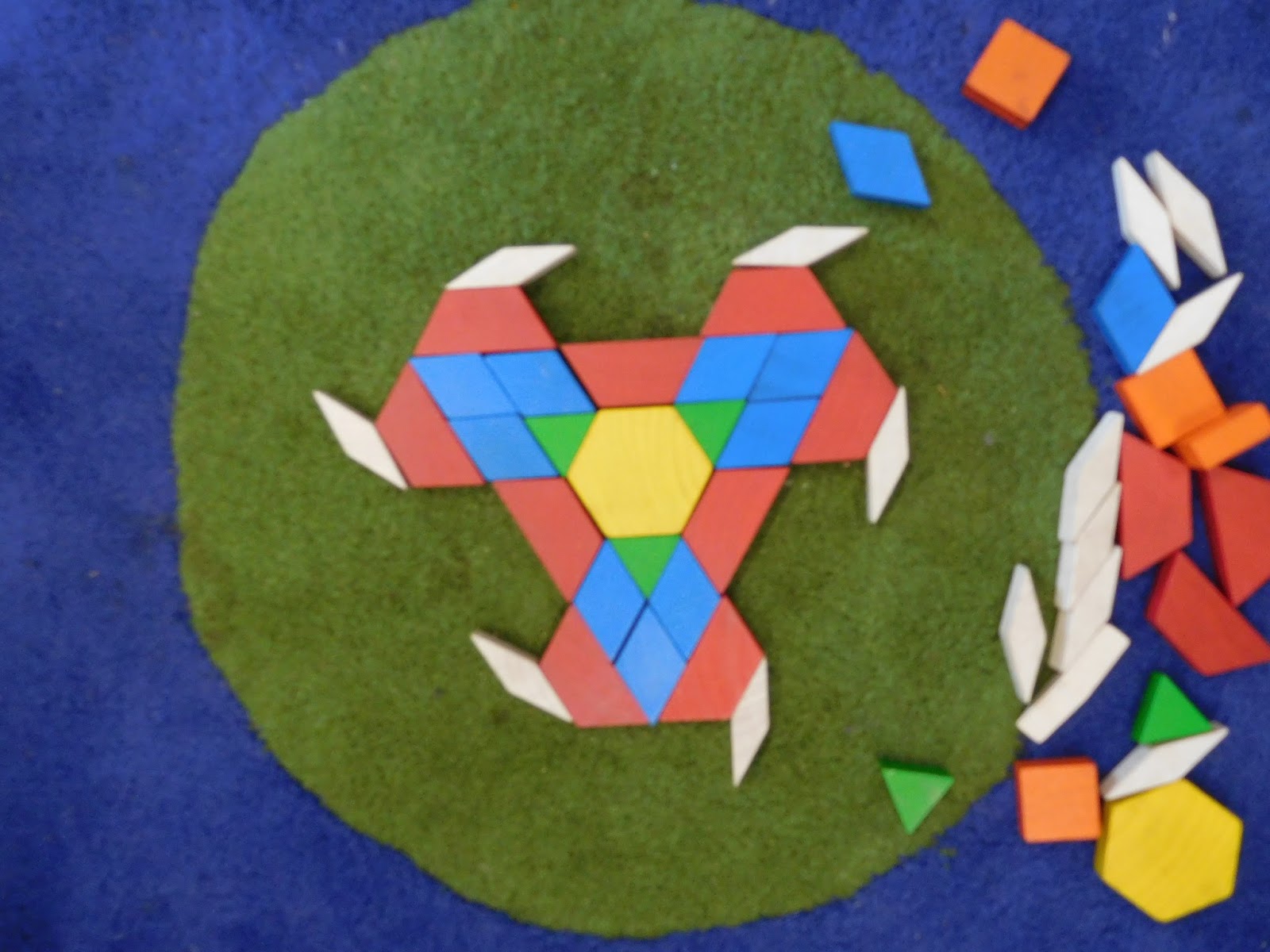
Patterns Inside a Circle


We are very lucky at our school to have some great resources.

Some of these may not be so obvious - like the big circle rug on the floor in my room. I decided today that we would use this rug as the base for our patterns.


So when the kids came in, they found I had put some materials in each circle. Some had pattern blocks, some had Cuisenaire rods.


The challenge - make a pattern inside the circle using the materials provided.

Here is what the kids came up with:


Linear Patterns


Bilateral Symmetry


Rotational Symmetry


Interesting the way the kids went about this. Some took quite a while to settle on an idea. Others made several patterns. A few wanted to make pictures - the Mona Lisa, a dog, even the clock was a bit "pictorial" before I probed a bit about the need to make a pattern.

There was very little copying - or "piggy-backing" on the ideas of others. Most of the students had their own creative solutions they wanted to explore. 

I was very interested to use this a bit of an assessment moment - how far had we got in two terms? 

Results - I was impressed at the spontaneity and individuality of the students. I saw examples of different types of patterns that we had explored already. I was also able to identify a few individuals who struggled to come to terms with the task.

This is our last week before the mid-year break. See you sometime in July.

Oh - and if you are coming to the AAMT conference in Canberra, come and say hello.


Friday, 14 November 2014

End of Year Reports Wordle

As is my habit now, I have completed a Wordle using the text from my end of year reports.

Here's what my comments about my kids looks like:


 I've posted it in "extra-large" size - I know it will go off the page a bit but it makes it easier to see.

I'm glad to see words like IDEAS and ABLE and GOOD coming across strongly. Good to know that these are the things I talk about most often in reports - especially the "ideas" thing.


Next level down we have INQUIRY and KNOWLEDGE and WORK and LEARNING and UNDERSTANDING and DISCUSSIONS. This is an interesting group - lots about the learning process. Glad to know that I am commenting about that.

A few maths words jump out - NUMBERS and MULTIPLICATION and DIGITS.

Something I do notice is that a lot of the Learner Profile words, that describe the individual and how they approach learning, and words that describe attitude are very small - something for me to reflect on. Next time I will...

Give it a go - drop your report comments into Wordle and see what comes up.


Monday, 2 December 2013

What did I learn in Maths this year?

On the front page of our school reports we have a section where the students have to write a paragraph, reflecting on their experience over the previous 6 months. It's a great opportunity for them to reflect on what they did, what progress they made and what they aim for next time.

Reading through the comments written by my class, I found there were lots of comments about Maths. So here is a selection of comments about what the students had to say about their learning in Maths in 2013:


Long Division


Long division was a bit of a preoccupation for Year 6 this year. The kids came in at the start of the year expecting this to be the ultimate experience of Year 6 maths. This came out strongly in their reflection comments:


One of my favorite things about this year has been long division. When I first tried it I had no clue but once it had been explained to me on how to do it I found it easy. I hope that next year I learn just as much.

I have enjoyed maths and art this semester because I liked learning about long division and long multiplication.

This year I have got a lot better at maths, learning lots of new things like long division.

Year 6 has gone so quickly but I have learnt many things. I learnt how to use a defibrillator, what happened at Cowra and how to use long division and long multiplication.

Math was the second best thing for me. I learnt how complex it really is. Long division was hard for me.


Place Value, Fractions and Decimals

This semester I have found decimals and chance in maths fun. I had fun doing chance because it was fun working in groups and completing activities. I liked decimals because it made everything a little harder.


I think I have also displayed a good understanding of long multiplication and regular multiplication.  Next year I hope to improve on my handwriting and learn how to do fractions because I just don’t understand them at all. 

Don't understand fractions at all? That's a bit of a worry...


My main strengths would be some aspects of maths like percentages, Mandarin and most things in music. My weaknesses would be most things in maths and some things UOI.


Fun, Enjoyment and Improvement


These are the ones that put a smile on my face and make me think I've done something useful this year.

I have greatly improved in my maths and I enjoy it a lot more than I used to.

I have learnt to enjoy maths because of all the activities that have been creative and challenging. Even though I still have a long way to go I think I will be more open to the new ideas of mathematics.

My goal for Year 7 is to have a deeper understanding of mathematical calculations.

Some of my strengths for this year would be P.E and maths.


I like solving maths algorithms.


Tuesday, 26 November 2013

My Report Comments Wordle

I've finished writing my class reports so I thought I'd do a Wordle of the Maths comments.

Here it is:


So, what does this say about me as a teacher?

Well - looks like some of our big topics this year were multiplication, fractions and decimals. Division is in there too. Hmm...lots about "number", what about the other elements of maths?

Knowledge, facts and understanding are all important.

There are a few positives in there - good, excellent, confident.

I'm a bit concerned that "practical" and "relationship" both get only a small mention. Why do I not make more comments about these aspects of learning? And what about patterns? Is that in there anywhere?

Try it yourself. Plug the text from your report comments into Wordle - see what comes out the other end.

Good luck!

Thursday, 26 September 2013

Bad Question

We were doing a bit of an assessment review and I threw in this question. Please note that I did not refer to the name of card game that the 4 friends were playing - it could have been just about anything:


As I was going around looking at what the kids were doing, it suddenly dawned on me that this was a really bad question, quite apart from the fact that this deck seemed to have three 9 of diamonds.

Each of the "hands" had exactly the same chance of happening. And I had asked about the chances of getting each particular hand.

Bad question.

According to a reliable source, there are 2 598 960 possible hands that you can be dealt in 5 card poker. So each of the hands illustrated above has the exact same chance of happening, that is 1:2598960.

I had given too much information. I should have referred instead to "one pair", "all 5 cards diamonds", "four 9's" etc.

Incidentally, there is a greater chance of getting dealt a pair (2860 possible combinations) than getting dealt nothing (1277 possible combinations). Who would have thought?

Hmm, good thing I don't play cards for money...


Monday, 17 June 2013

Fractions Assessment - Part 2

So, we talked yesterday about how I had done some assessment of our learning about fractions. I posted some student comments on a few diagrams that had inaccuracies and problems. The responses were very illuminating.

Anyway, the assessment continued with a few pretty standard questions sorting out some knowledge about adding and subtracting fractions - nothing ground breaking. 

The last question is what I want to share. It asked students to complete some sentence starters. 

Here are a few things they said.


Complete these sentences...


a) Fractions are....

a way of representing something that is not quite a whole

pieces of things that are divided up

a way of showing non-integers

a part/portion/piece of a whole

dividing between the denominator and the numerator


b) When you add two fractions, you have to....

add the numerators together if they have the same denominator

GUESS

add the numerators together unless the denominator is different then you have to x it by something else to make it the same

I don't know exactly what to do but I suggest you draw a pizza

If they have a common denominator then you  merely add up the top numbers but if they don't you can draw a picture or find a common denominator


c) You use fractions when you....

divide up things evenly or to represent something that is not whole

are cooking. e.g. pour 2/3 cup of cocoa powder in the cake mixture

cut up fruit

are trying to divide things into different parts

can't make a whole

cut a pizza, build a building, pour some milk

have a pizza and your friend says I want 3/4 you have to work out that you don't get much


There were lots of other responses - too numerous to mention here - but by being able to hear what they all said gave me a real insight into their thinking.

I am in a  position now to identify who needs a bit more support, who has really got it and who is ready for the next challenge.

In so many ways, a successful assessment.


Sunday, 16 June 2013

Fractions Assessment

Well, we got to the point where we were ready to assess our work on Fractions, to see what we had learnt.

We use a variety of assessment tools, including pencil and paper.

I was interested to see if the kids could explain why some understandings of fractions might be inconsistent, fallacious or even straight-out wrong. So I gave them a few non-examples and asked them to explain what they thought was wrong with the diagram.

Here's some of the responses.


Task - Can you explain what is wrong with each of these examples?


Example 1


The quarters are not equal.

?

The fractions aren't shaded fully.

Not equal = no fractions

All of the fractions are different sizes so they're not fractions.

The four sections are not divided equal. It is important for each section to be equal to make the fractions true.

The bottom and the top of the circle are different areas from the middle.

Bad colouring.

This is wrong because the are of each shape is different. If it is going to be even then it should be cut like a pizza.

✔ Perfect

The quarters are not coloured in properly.


Example 2


 One is bigger than the rest.

Just like the first example this fraction is uneven. Each of the thirds is its own size and they are not equal.

The middle part is bigger than both the other parts making it unequal.

All the squares aren't measured to the correct measurement so they're everywhere.

The lines are slightly off so it's not equal.

The area is not the same as the other parts.

Using grids to shade fractions makes it look like there are more than 3 sections. The thirds are not equal!


Example 3


The blacks are scattered.

It's wrong because 1/4 isn't shaded. 6 squares are supposed to be shaded.

The quarters are not accurate.

The fractions are split up all over the place.

Not enough fractions are shaded to get the right fraction. The fraction would be 1/6.

It's not showing 1/4 of the rectangle.

A quarter is not shaded in and it would make more sense to put the shaded parts in line.

It is not a quarter of 24.

Not enough squares are coloured in and it is not very easy to understand.

Well, unlike the other example, this one is even as in shape and the dividing up of the box. But it is false. It says it is 1/4 of this box but it is wrong. It would be 1/6 of this box.


Reflection


I have not included every response here - only a select few of those that were interesting for one reason or another. There were many children who got the idea for each picture but it was not important to include all the similar answers.

So, it is interesting to see the things that act as distractors for the kids and get them off topic.

Colouring and shading seem to be pretty significant for some kids. It is the thing they focus on first of all. 

Also, many seemed to want the shaded sections to be grouped together - but instead maybe they should have been exposed to more examples where they were not.

The diagrams themselves need to be unambiguous. The picture is meant to help the kids see the idea - not confuse them even further.

Lots for this teacher to think about. Some good responses but also some areas that still need clarification.

We will revisit this topic again later in the year...