You've probably read the many articles and pages written about the power of "Yet" - adding this small word to the end of "I can't do this..." make so much difference.
The idea is for the kids to reflect on their work and if there is something they don't understand (yet) they can get one of these tags and glue it next to their work.
Very popular. I was overwhelmed by the response of the kids. Even those who I think really did understand, wanted to put one in their books!
So I have now made a second tag:
This is for when you DO understand what you are doing, when you do "Get it" and can demonstrate your understanding.
Last week our Year
6 classes did their PYP Exhibition. It was amazing. Such a great
opportunity for the kids to celebrate their journey through the PYP. I am always keen to see how they will use mathematics. They never disappoint me with the creative ways they look at things. So here are a few precious examples from last week.
The first thing I noticed was some clever use of infographics. The kids had been shown the Piktochart website and ran with it. Here are a few nice examples:
This group used an infographic to present results from a survey they did to find information about technology use and addiction.
This group used their infographic to present information they found in their research
Other groups used "live" surveys to ask visitors to answer a question. They found some great ways to present their results that they built up over the Exhibition period.
This group was asking a big question about racism in sport...
...and they got respondents to place a pin with a football into the pitch to show their answer.
The question of what to do with refugees - voting by marbles.
I really liked this one. You got to put your vote in the balance scale and each ping pong ball had a positive message written on it.
This was a fund way to vote - and the kids loved it.
This called for a tough decision - which is a more significant problem: child soldiers or post traumatic stress disorder in returned service personnel?
The votes were cut into leaf shapes to represent a "tree of hope".
So once again I was very impressed. I hope you enjoyed seeing what the kids came up with.
This week we planned to do "Fractions". I know - stand alone content taught out of context. So I shook it up a bit and made a website full of lots of fun activities. Here it is. Hope you enjoy looking at it.
I was working with Year 2 the other day. They were keen to do some work with arrays to look at multiplication. I was keen to make it a bit of fun. So, I thought, lets put the array thing together with some shapes that we need to find the area of. I constructed the following set of shape outlines:
Then I asked the kids to find the biggest one and the smallest one. Fortunately I had made the sides of all the shapes whole centimetres, suggesting to the kids that they could use Base 10 blocks to work out the area of each shape. (Just to be tricky, I made the task a bit ambiguous - there are several shapes that all have the same area - some are big and some are small. I wanted to see what conversation would come out of that.) And here's what they did:
So we can put the Base 10 blocks onto the shapes to find how many cover it.
This one looks really big - it's soooo long!
Might need to use some units and well as tens.
Hmm, several of these are 24 square cms.
But why are they hanging over edge of the shape? asks the teacher.
Well, there's 2 hanging over so it must be 8 long (10 - 2 = 8) so 3 x 8 = 24! says the student.
And same again! 10 - 4 = 6.
So 4 x 6 = 24.
Smart kids! It's easier (less fiddly) to use the 10 blocks than getting all the units blocks out. And yes, they were doing multiplication and arrays and area all in one go.
I was at the Canberra Maths Association conference a few weeks ago and saw this really simple idea from Maria Quigley from the University of Sydney. When making models of 3D objects, Maria used those really jumbo sized plastic straws you get at some "bubble tea" outlets. They are useful because you can pass a string through the straw (several times if needed) and tie your shapes together. So I had a go in my classroom. I bought a few packs of these straws, which are available pretty cheap at some $2 shops. We all sat down and had a go at making a tetrahedron. Here are a few of our results:
Note - collaboration; when we work together we learn so much more.
They all looked pretty good when I hung them up.
But of course I am an annoying teacher. I wasn't prepared to let it rest at that. So I started asking some questions. "What if....?" "And if we got 2 of them and....?" "And could you...?" And suddenly the kids were making some discoveries, like: "Hey, I can't make this cube stay up." "Is this a triangular prism?" "What do you call this shape when you put two tetrahedra together?"
And then they started to construct models of objects I had no idea what to call. This is how we learn.
We are launching into our inquiry into "How We Organise Ourselves", using the Australian Parliament as our primary inspiration as a system that is organised. So far it has been a lot of fun. Part of this inquiry has involved us in creating our own country and parliament to run it. We started with a large blank sheet of calico and each student got to draw part of the coastline.
Of course we had to find a name for our country. Being a democracy, we implemented a complicated series of nominations and votes. The winner was "Fuzzington".
Once the outline was established, we added cities, towns and geographical features. A bit of mapping was required so we found out about "BOLTSSNA", an acronym close to the hearts of Year 7 geography teachers everywhere.
O = Orientation
L = Legend
S = Scale
Lots of opportunity here for maths learning and inquiry.
With our newly established country, we needed some infrastructure. So I gave each student $50 000 000 - I'm generous like that. First item on the agenda was road building. At $1m per cm, it wasn't going to be cheap. Lots of measuring, calculating and negotiating ensured. But the benefit in building a road was that your electorate would get $5m next financial year for each town it was connected to. You've got to spend money to make money. The game has evolved since we started. Each electorate now has a major industry. We held elections and now have a government, opposition and several independents. We spend time each day debating bills and making laws for Fuzzington. I try to run a new financial year each day so that the money keeps turning over and the country develops. This morning we voted for a high speed rail connection to be built. Now where will it go? What will it cost? Whose towns will get connected? What benefits will there be if you are connected by train? So many questions. So much maths...
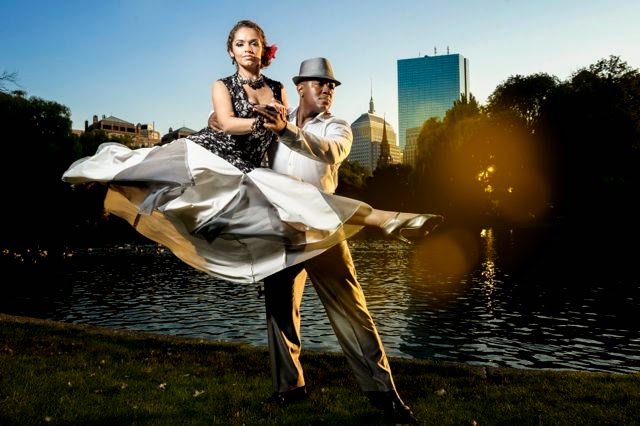
Dancers are busy people - and no two are busier than Joel and Ana Masacote, legends in the field of Latin Dance. So, it was really great to get a reply from Ana saying that Joel and she would also love to participate in the "Maths in Dance" project. I realise we are a few weeks past the end of August but this was too good an offer to let slip past.
So, who are Joel and Ana Masacote?
This husband and wife team is one of the most
sought after in salsa/mambo. Respected for their artistry and musicality, they
have taken the interpretation of Salsa Dance to new heights. Ana and Joel
Masacote have taught in 30+ countries, across 5 continents and countless cities
throughout the world. They are booked as far as a year in advance and almost
every weekend in between to teach and perform around the world.
When not traveling to some exotic country, you
can find Ana and Joel in Boston, MA teaching salsa and latin dance to all
levels from beginners to advanced master classes, along with their professional
dance troupe of instructors in the Masacote School and Dance Company.
Both Joel and Ana gave up some of their precious time to answer 10 questions for me about how mathematics relates to their passion - dance. We will start with Joel and hear what he had to say:
The questions and answers from Joel:
1.Describe what math lessons
were like for you at school.
Math was one of the subjects that I
enjoyed! Algebra, Geometry and Music were the only math classes I took in
high school.
2.When you left school,
did you expect to be using any of the math that you were taught ever again?
I wasn’t sure what was going to happen with Algebra & Geometry, but
the math in Music becomes an intuitive feeling of math, and it has always been
my life.
3.Do you divide dances or
movements into parts or sections that might be expressed as mathematical
fractions?
I think
of dance and movement in the same light as Music, so putting them into parts and
sections are a typical part of the creation. However, I don’t think I’ve ever
divided them to be seen as fractions. Interesting viewpoint to explore! ;)
4.How aware are you of angles
in dancing technique – angle of body, angle of arms and legs, angle of
movements?
This is
where my geometry lessons came into play. I trained in
J.R.O.T.C (Junior Reserve Officer Training Corp) in high school for
4 years. I loved formations because I saw the angles of body & angles
of movements as geometry. Our steps always had to be synchronized, so my
music (time & rhythm) was a huge part of this process as well. Geometry
made me fall in love with billiards! I played for the billiards team while I
was in college at Howard University for 2 years. So, I see dance mainly in the
angles I get out of the geometry.
5.When dancers are
moving in a performance, how much is “mathematical thinking and calculating
where the space is” and how much is “feel for the space”?
I like to feel the space the body is in. My last
year in J.R.O.T.C I became the company commander for the silent drill team and this really
started to push my awareness of space and bodies in space. It expanded my love
for geometry even more. After high school I did four years in the Army and
another four years in the Marine Corps, so my spacial awareness to bodies of
people flanking, filing and angling in synchronized motion became a huge part of my
life. I loved calling cadence (even though I don’t remember much any more)! The
entire interaction with leading a platoon was musical for me and the
interaction with the platoon singing cadence was always an amazing and intense
experience!
6.Is estimation good
enough or do you rely on accurate measurement of distances and times?
With
twelve years of military experience in marching and leading formations, and
thirty years of musical experience maintaining consistency of time, rhythm
and shape of sound, accurate measurement of distance, duration
and time is a huge part of the process in creation for me.
7.How aware are you of timing
and beat in dance?
This is
one of my favorite topics. Time is everything and at the same time it’s
nothing. It’s a representation of yin and yang… Tension and relaxation.
Duality. Time is the primitive place where sound and motion is created,
and they happen simultaneously in that moment in time. So, Music and Dance are
one in the same. It all starts from intention. The intention to create. The
intention to expand. The intention to express. Maintaining the consistency of
time... i.e. pulse, rhythm and vibration, we begin to see that the past and the
future are only concepts. They aren’t real. Allowing the mind, body and soul to
focus on the maintaining of time, treating every moment in time as if it’s the
only time, we then witness the past, present and future happening all in the
present moment. The past is happening in your reflection of it, and the future
is happening in your desire for it, but they are all happening in the present.
Music, Dance, Martial Arts or any creative process for that matter allows the
mind to practice focusing on the moment in time. The more you evolve with your
craft, constantly fine tuning it to please your soul, the stronger you become
aware of this illusion.
8. Have you ever used math and physics to explain your technique, movement or
choreography?
All the
time.
9. Do you look at statistics much to analyse your art?
No. For me, statistics do not define art. Embracing life
experiences and channelling it into a pure self expression is how
I analyze my work.
10. Do
you have any other insights to offer into how you use mathematics in dance?
We as a human race are becoming more aware of ourselves.
This is only the beginning. The boundaries and pigeon holds the system has on
us from seeing the different illusions, are falling. We are beginning to
express ourselves on a whole other dimension. Slowly being introduced to the
4th. The universe is expanding, and the vibrational frequency of the universe
is speeding up our perception of time. Earth is going through a frequency
shift, and this shift is shaking things up. It’s allowing humanity to see the
through self. So, my strongest advice is to allow yourself to express
wholeheartedly without any boundaries or perception blocks of understanding
self! We are one! This understanding is from my exploration into Sacred
Geometry, the mathematics of all sound and frequency. Everything in
existence has it’s own frequency, which is also defined by math and is measured
in hertz. Love is the highest frequency, and living completely in love
with self, we heal our planet. So, Love thyself!
Questions and answers from Ana:
1.Describe what math lessons were like for you at school.
Math was always one of my favorite subjects. With just a bit of
problem solving, there was always an answer to every question. In high school,
I was skipped up from geometry (later testing out) and placed in a new fast
track math program in which you were taught your first two years of math in
college (Calculus AB & BC) by the time you graduated. Eventually, my love
of math (and computers) led me to study electrical engineering and computer
science at Massachusetts Institute of Technology (MIT).
2.When you left school, did you expect to be using any of the math that you were taught ever again?
In college, I switched into business when I decided I didn’t love
engineering enough to do it as a living and wanted instead to build my own
entertainment company. At that point, I figured I’d be using basic math through
the business component of the company but never realized how much I would also
be using it in my dance and movement.
3.Do you divide dances or movements into parts or sections that might be expressed as mathematical fractions?
The co-founder of the company is also a musician, and he has helped
us develop a musical foundation tied into our dance curriculum so they work
hand in hand. We teach dance by breaking down the components of the music, odd
timing variations, and notations. We explain the concept of whole notes,
quarter notes, eighth notes, etc. We talk about the subdivision of time so
dancers can fit steps within such rhythms as half beats and triplets, allowing
them to stay better attuned to the music. For our dance company, this becomes
even more present when working on choreography and staying in sync with one
another.
4.How aware are you of angles in dancing technique – angle of body, angle of arms and legs, angle of movements?
Angles are extremely important and emphasized both for social dance
execution and performance presence. For social dancing, dancers must be aware
of angles to partners at all times. Half the lead is signaled through the
positioning of body in space rather than physically leading a move. Salsa can
be both linear and circular. The style we focus on is linear, through which
leaders must be aware of how to use the angle of the body to open up space for
the followers while followers must be aware of the angle of the frame to the
partners so as not to inhibit the lead. We often talk about 90 degree frame
positions, 180 degree travel, and even some of our moves are called by names of
angles, such as the 360.
Carrying that further into performance, lines become thoroughly emphasized when
working on presence and synchronicity. We establish positioning of arm and leg
styling by use of angles, body position by symmetry, presence by parallel and
perpendicular forms, and other similar uses. In a show, I know exactly at what
angle my arm, body, head, leg, etc. need to be.
5.When dancers are moving in a performance, how much is “mathematical thinking and calculating where the space is” and how much is “feel for the space”?
Spatial awareness tends to be more of a feel of the space with set
boundaries. For shows, we must decide center stage, stage boundaries, and in
which portion of the stage we must begin, end, and dance within. For example,
we might have a situation in which spotlight shines center stage, and when lights
open fully, we must stay within a 2/3 area of the stage where lights are
shining. After setting guidelines, the remainder becomes a “feel for the space”
as we perform.
Formations require a really important feel of both the space and people around
you. When you are developing shapes as a group, everyone has to be tuned into
the distance of one person to the next and placement within the stage.
6.Is estimation good enough or do you rely on accurate measurement of distances and times?
Accurate measurements are important in defining how much space we
have to use to make sure choreographies are workable within the limits.
Estimation is good enough for everything thereafter, unless we want a
particular formation that involves set spotlights/ lighting requiring dancers
to lead in an exact area.
7.How aware are you of timing and beat in dance?
Timing is one of the most important subjects in our school. We
actually teach music classes in addition to dance classes to keep people
connected to what dancing “in time” really means.
Our style of dance uses syncopated counts in which dancers sometimes step
between beats and not always right on top of pulse. This requires one to always
be attentive to the present moment at which the count is happening and maintain
an internal pulse (think of a ticking clock) while coordinating steps both on
and between pulse at any given time. The body is maintaining a separate rhythm,
and it is very common to switch from a syncopated time to one right on top of pulse,
depending on the step, requiring the dancer to always be attentive to the space
and duration of one beat to the next.
8. Have you ever used math and physics to explain your technique, movement or choreography?
Although I loved math, I disliked physics. However, even then, I do use physics terms at times to explain
connection to partnering, force applied in lead/follow, and execution of lifts
and dips. Math (mostly geometry) terms are often used in explanation of
movement, technique, and choreography.
9. Do you look at statistics much to analyse your art?
I actually think statistics might be the one subject I don’t use in
the explanation of my art, but then statistics and probability were my least
favorite math subjects. J I love spontaneity!
10. Do you have any other insights to offer into how you use mathematics in dance?
One of our company’s most famous choreographies is “Take Five”,
danced to Dave Brubeck’s famous jazz song in odd 5/4 timing signature. To
choreograph to it, we had to develop a way to dance salsa (normally in 4/4
timing) to it. We took 6 steps over an 8 count and adjusted them to 6 steps
over a 10 count, requiring an upswing and tap of the step to fill duration of
time. Since, we have experimented with different timing signatures and continue
to explore new ways of movement in time.
Back in 2002, I was the Latin Dance Coordinator for a sister city project between
the city of Cambridge, MA and Cienfuegos, Cuba. On this trip, I had the
opportunity to listen to a kids’ band with a very unique teaching method. In an
effort to help at risk kids who were having trouble with math studies, the
teacher had developed a program in which he would teach them how to play music
through the explanation of math. It was the 5th cycle of the program
and had been very successful in getting the youth to become more interested in
their studies and more understanding of math subjects. I thought this was a
particularly profound and benevolent idea as he was helping them become
successful students in a fun and yet systematic way. I hope more programs like
this are eventually developed, but it is also a very innovative idea to try to find
a similar approach through dance.
Thank you Ana and Joel for such wonderfully detailed and thoughtful responses. I really love the idea of salsa to "Take 5" - see the video above, it is amazing!